Timing Acquisitions in Long-Term Economic Cycles
Economic cycles shape acquisition costs, financing terms, and competition. Learn how to time and structure deals around DSCR, SBA rates, valuations, and debt cycles.
 Samson JagorasPrincipal & CEO/CIOJune 9, 2026

Get matched with the right lender for your business
Compare offers from our vetted network. Pre-qualify in minutes — no impact to your credit.
Buying a business? Timing matters more than you think. Economic cycles directly affect acquisition costs, financing terms, and competition. Here's what you need to know:
- Rising Costs: Median cash-flow multiples for SBA-financed deals increased from 2.85x in 2022 to 3.71x in early 2026.
- Stricter Lending: Debt Service Coverage Ratio (DSCR) requirements tightened, now ranging from 1.30x to 1.60x.
- Higher Interest Rates: SBA 7(a) loan terms and rates currently range between 10.5% and 13.5%.
Understanding economic and debt cycles is crucial for identifying the best time to buy. The best opportunities often arise during uncertain market conditions, like recessions or troughs, when prices drop and competition eases.
To succeed in today's competitive landscape, focus on deal structures that align with lender criteria, such as DSCR thresholds, and target industries or regions positioned for growth. If you are ready to buy a business, start by evaluating current listings.
Understanding Long-Term Economic and Debt Cycles
Economic cycles play a huge role in shaping deal prices, lending standards, and the level of competition among buyers. To make smart acquisition decisions, you need to grasp not only short-term rate changes but also the deeper, long-term trends driving these shifts. Let's break down the key phases of economic cycles and how they influence market conditions.
The Main Phases of Economic Cycles
Economic cycles typically move through five distinct phases:
- Expansion: Credit flows freely, revenues grow, and valuations rise.
- Peak: Valuation multiples hit their limits, lending becomes more restrictive, and buyer competition intensifies.
- Contraction: Revenues decline, and distressed sellers create more active deal opportunities.
- Trough: Prices hit their lowest point, revealing excellent long-term opportunities, even though market confidence is at its weakest.
- Recovery: Early buyers benefit as valuations begin to climb again.
The takeaway? The best buying opportunities often arise when the market feels the most uncertain.
How Long-Term Debt Cycles Affect M&A
Long-term debt cycles, marked by gradual credit expansion followed by economic strain, set the boundaries for both leverage and valuations in acquisitions. For example, during the peak of the long-term credit expansion around 2021, acquisition leverage reached 6–7x EBITDA. Fast forward to 2026, and that ceiling has dropped to 4–6x EBITDA as lenders adjust to heightened risks. Recognizing these shifts in debt cycles is essential for timing acquisitions effectively.
"Capital stack design is the most under-engineered piece of small-business acquisitions... The financing decision shapes deal economics more than most buyers realize." — Christoph Totter, Managing Partner, CT Acquisitions
How Long-Term and Short-Term Cycles Interact
Short-term rate changes don't operate in isolation — they often amplify the effects of long-term debt cycles. For instance, when both cycles tighten simultaneously, the impact on deal economics becomes even more pronounced.
Consider this: The WSJ Prime Rate surged through 2023, peaked, and then started easing with rate cuts in late 2024 and into 2025. Yet, despite this easing, lenders in 2026 are stress-testing deals at +200–300 basis points above current rates, a direct response to the 2023 peak. This means even a small rate increase could cause a deal to fail under stricter lender criteria. To adapt, lenders have raised DSCR (Debt Service Coverage Ratio) thresholds to 1.30x–1.60x.
Aligning Acquisition Strategy with Economic Cycles
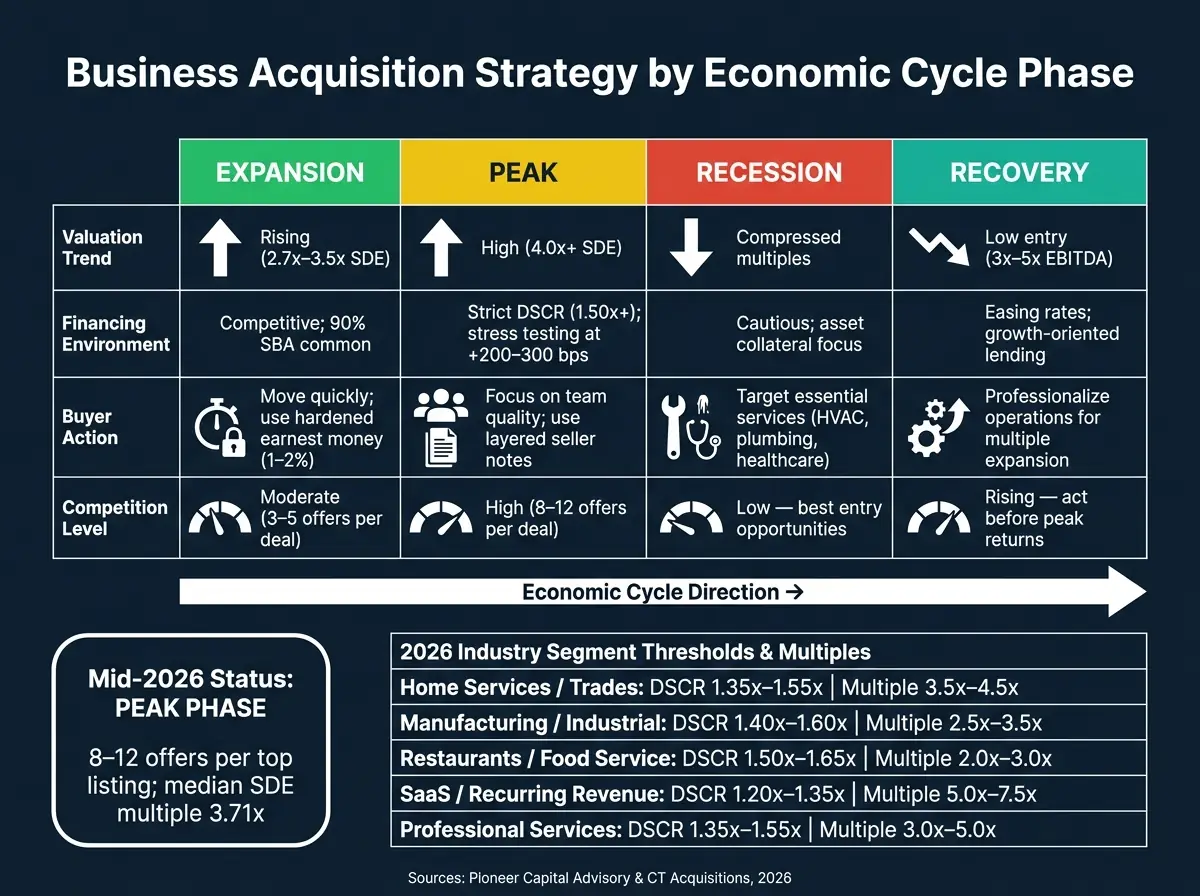
How Valuations and Risk Change Across the Cycle
Where you stand in the economic cycle plays a huge role in determining the price you'll pay, the financing terms you'll get, and how much risk you'll face. For instance, median cash-flow multiples for Main Street businesses climbed from 2.52x in 2022 to a high of 4.25x in 2025, before settling at 3.71x in early 2026. This upward trend reflects a shifting risk landscape for buyers depending on the cycle stage.
At the same time, financing has become more challenging. Lenders now demand 1.30x–1.60x DSCR (Debt Service Coverage Ratio) on straightforward deals. A transaction that would have easily passed underwriting just a few years ago might now require additional equity, a seller note, or both.
"The median multiple on closed deals settled around 4.10x [in 2025] — a meaningful step up from the 2022 baseline." — Matthias Smith, Founder, Pioneer Capital Advisory
To navigate this, structuring deals backward from DSCR is key. This approach is particularly effective when using SBA 7(a) loans for business purchases, where cash flow coverage is a primary underwriting requirement. Instead of focusing solely on the purchase price, start with the DSCR a lender is likely to approve — typically around 1.35x to 1.55x — and then build the capital stack accordingly. By 2026, nearly half of all closings required layered seller financing to bridge the gap between higher valuations and stricter lending standards.
These shifts highlight the importance of considering not just the broader economic cycle, but also how industry-specific and regional factors influence valuations and risk.
Industry and Regional Cycle Differences
Understanding how industries and regions behave within the economic cycle can help you time acquisitions more effectively. While knowing how valuations and risks shift across the cycle is vital, industry and regional nuances add another layer of strategy.
For example, acquiring a vertical SaaS company involves different underwriting criteria compared to buying an HVAC services business, even if the deal sizes are identical. Here's a snapshot of how key industries stack up in 2026 based on DSCR norms and valuation ranges:
| Industry Segment | 2026 DSCR Threshold | Multiple Range (EBITDA/SDE) |
|---|---|---|
| Home Services / Trades | 1.35x – 1.55x | 3.5x – 4.5x |
| Manufacturing / Industrial | 1.40x – 1.60x | 2.5x – 3.5x |
| Restaurants / Food Service | 1.50x – 1.65x | 2.0x – 3.0x |
| SaaS / Recurring Revenue | 1.20x – 1.35x | 5.0x – 7.5x |
| Professional Services | 1.35x – 1.55x | 3.0x – 5.0x |
(Source: Compiled from Pioneer Capital Advisory and CT Acquisitions data, 2026)
Take restaurants versus SaaS as an example. Restaurants need the highest DSCR cushion — 1.50x–1.65x — but come with the lowest multiples due to revenue instability and thin margins. Meanwhile, SaaS businesses enjoy lower DSCR requirements, thanks to their reliable recurring revenue, and command multiples as high as 7.5x.
Regional trends also matter. Markets in the Sunbelt, like Texas, Florida, and the Carolinas, are still growing in sectors like home services and light industrial, driven by population increases and construction activity. On the other hand, some Rust Belt manufacturing hubs are closer to the bottom of the cycle, offering lower entry prices but slower recovery timelines. Aligning your target industry with both national trends and regional economic conditions can give you a clearer sense of when to act.
A Cycle-Phase Strategy Matrix
Here's how acquisition strategies shift depending on where we are in the economic cycle:
| Cycle Phase | Valuation Trend | Financing Environment | Recommended Buyer Action |
|---|---|---|---|
| Expansion | Rising (2.7x–3.5x SDE) | Competitive; SBA 7(a) and 504 loans are common | Move quickly; use hardened earnest money (1–2%) |
| Peak | High (4.0x+ SDE) | Strict DSCR (1.50x+); stress testing | Focus on team quality; use layered seller notes |
| Recession | Compressed multiples | Cautious; asset collateral focus | Target essential services (HVAC, plumbing, healthcare) |
| Recovery | Low entry (3x–5x EBITDA) | Easing rates; growth-oriented | Professionalize operations for multiple expansion |
In the late-cycle conditions of mid-2026, peak-phase strategies are particularly relevant. Quality listings are now receiving 8–12 offers, compared to just 3–5 in 2022. To win deals, buyers need more than just a strong bid. Lenders are looking for businesses with a solid management team in place, not operations that depend entirely on the owner.
"The businesses fetching the strongest multiples share a specific profile that has very little to do with their industry and a lot to do with their team." — Matthias Smith, Founder, Pioneer Capital Advisory
Having named leaders for operations and sales significantly boosts financing prospects and valuation potential. In today's market, human capital is as much a financing factor as it is an operational one.
Key Indicators for Timing Acquisitions
Building on the earlier discussion of economic cycles, these indicators help pinpoint the best timing for acquisitions, aligning them with broader long-term economic trends.
Core Macroeconomic and Credit Indicators
Successful acquisition timing often relies on observing multiple economic indicators moving in sync. A key starting point is the trajectory of interest rates. For example, SBA 7(a) loans currently carry rates of around 10%–11% (based on the WSJ Prime Rate plus a spread) as of mid-2026. Lenders are also stress-testing deals against potential rate increases of 200–300 basis points, which serves as a critical signal.
Another important factor is the rising Debt Service Coverage Ratio (DSCR) floor. By 2026, this range has climbed to 1.30x–1.60x, which means fewer deals meet cash flow requirements at current valuations. This shift often marks the early stages of a recovery in the economic cycle.
"Lenders are stress-testing today's pricing against the rate trajectory still in living memory and unwilling to underwrite without coverage cushion if Prime climbs again." — Matthias Smith, Founder, Pioneer Capital Advisory
These macroeconomic signals provide a foundation for understanding broader market conditions.
M&A Market Indicators to Watch
While macroeconomic trends offer a big-picture view, market-specific data provides real-time insights into deal activity. Metrics like deal volume and buyer competition reveal the immediate state of the market. For instance, Axial reported a record 12,856 deals brought to market in 2025, a 17% increase from the prior year. During the same period, there was a 36% increase in new buy-side members. This surge in buyer activity, combined with a relatively stable supply of quality businesses, has driven up pricing and reduced negotiating leverage for buyers.
Another important measure is the buyer-to-deal ratio. By mid-2026, the SBA acquisition market showed approximately 8.5 active buyers for every locked-up deal, a significant jump from the 3:1–5:1 ratio seen in 2022. This heightened competition results in higher multiples, quicker deal timelines, and less room for negotiation. Median SDE multiples for SBA-financed deals, for example, have risen from 2.85x in 2022 to 3.71x in early 2026.
Additionally, tracking how closely deals close to their asking prices provides a snapshot of market strength. In 2025, businesses sold at about 94% of their asking prices, underscoring a strong seller's market with little flexibility for price reductions.
Building a Monitoring Dashboard
To stay ahead, consider building a monthly dashboard that tracks key metrics like the current WSJ Prime Rate (and its 12-month trend), median SDE/EBITDA multiples by industry, updated DSCR thresholds, deal volume, and buyer-to-deal ratios. This comprehensive view can help maintain a cycle-aware approach, crucial for negotiating favorable terms.
For deals exceeding $2.5 million, incorporating a third-party Quality of Earnings (QoE) report early in the process can be a game-changer. Adjusting SDE by 8%–15% based on these reports can significantly impact DSCR compliance.
Platforms like Clearly Acquired simplify this process by integrating financial analysis, lender screening, and deal underwriting into one system. Leveraging such tools before submitting a Letter of Intent (LOI) can streamline decision-making and provide a competitive edge in today's dynamic market.
Building a Cycle-Resilient Acquisition Program
To navigate economic cycles effectively, a resilient acquisition strategy must position you to act decisively at any point — whether the market is booming or contracting.
Long-Term Planning Frameworks for Buyers
A cycle-resilient acquisition program starts with a focus on capital structure as a core strategy, not an afterthought. The key is to work backward from the Debt Service Coverage Ratio (DSCR). Instead of zeroing in on a target purchase price, calculate the maximum debt the business can handle and base your offer on that figure. This approach prioritizes risk management, especially during unpredictable economic phases. With SBA 7(a) rates currently at 10%–11% and lenders stress-testing with an additional 200–300 basis points, buyers using this method are better equipped to secure financing.
Another critical step is including a 3–6 month working capital reserve in your acquisition budget. Unexpected challenges — like customer transitions, staffing gaps, or deferred capital investments — can deplete cash reserves quickly if not planned for.
This disciplined financial planning naturally aligns with leveraging technology to make informed, cycle-aware decisions.
Using Clearly Acquired's Platform for Cycle-Aware Acquisitions

To execute a cycle-aware acquisition strategy, you need access to real-time data, fast underwriting, and the right financing options. Clearly Acquired offers an AI-powered platform that combines all these elements in one place.
The platform provides buyers with AI-driven financial analysis, lender matching based on real underwriting criteria, and tools to streamline deal management. For transactions over $2.5 million, it includes a Quality of Earnings service that reconstructs earnings from source documents — like tax returns, bank statements, and contracts — producing lender-ready reports. These reports often adjust stated Seller's Discretionary Earnings by 8%–15%. In today's competitive market, this speed and accuracy can make all the difference.
Building Decision Discipline Across the Cycle
While structural strategies set the foundation, maintaining behavioral discipline ensures consistent execution. At market peaks, fear of missing out can tempt buyers to overpay or accept thin coverage ratios. During downturns, hesitation might lead to missed opportunities.
"The hardest part is not finding a target. It is turning down one that almost fits." — Ilia Lotov, Founder, Kaizen X Capital
Structured decision-making rules can counter these tendencies. For example, always confirm that a deal meets a 1.40x DSCR at current rates and at rates 250 basis points higher before submitting a Letter of Intent (LOI). Additionally, committing to a working capital reserve at the LOI stage — with a post-close adjustment — can help avoid price drift and reinforce financial discipline.
"The buyer who shows up with a structure designed backward from achievable DSCR thresholds... closes faster and with better terms." — Matthias Smith, Pioneer Capital Advisory
Key Takeaways for Timing Acquisitions
The analysis of long-term economic cycles and acquisition timing highlights some crucial trends: SBA-financed deal multiples have risen sharply, and DSCR thresholds have tightened significantly since 2022. Ignoring these changes could derail a potential deal.
Given these shifts, structuring offers around actual debt capacity is more important than ever. Financial feasibility should be confirmed before entering price negotiations. One key indicator of a business's resilience during economic shifts is a seller's willingness to carry a note, particularly one tied to performance metrics.
"Capital stack design remains an overlooked aspect of acquisitions. Buyers spend months negotiating purchase price... then casually accept whatever the SBA bank approves." — Christoph Totter, Managing Partner, CT Acquisitions
The competitive landscape has also evolved. By 2026, top-tier listings are seeing 8–12 offers each. Meanwhile, the share of deals closed by private equity and independent sponsors dropped to 45% in 2025, compared to 61% in 2021. Family offices, on the other hand, now account for 30% of deals. Interestingly, the buyers securing deals aren't always the highest bidders; they're the ones who come prepared with clean deal structures, verified financials, and lender-ready documentation.
In this increasingly competitive market, having strong technical support can make all the difference. Tools like Clearly Acquired's AI-powered platform are designed for this fast-paced environment. They streamline diligence processes, connect buyers with lenders using real underwriting criteria, and produce Quality of Earnings reports that adjust stated SDE by 8%–15% in nearly half of the deals analyzed. With speed and precision being critical, having the right infrastructure isn't just helpful — it's a decisive advantage.
FAQs
How can I determine the current phase of the economic cycle?
Tracking interest rate trends and lender sentiment can help pinpoint which phase of the economic cycle we're in. Keep an eye on the WSJ Prime Rate — a pattern of sharp increases followed by cuts often signals a shift in the cycle.
Also, observe lenders' Debt Service Coverage Ratio (DSCR) thresholds. When these comfort zones tighten, it suggests reduced debt availability, while loosening indicates a more favorable lending environment.
Lastly, compare current buyer demand per listing to historical acquisition volumes. This can highlight whether the market is experiencing a high-demand phase or one with softer multiples.
What DSCR does my deal need to qualify for SBA financing?
To secure SBA financing, lenders typically expect the target business's historical cash flow to exceed the proposed debt service by at least 1.25x. This is known as the Debt Service Coverage Ratio (DSCR). Lenders calculate DSCR using the seller's tax returns, adjusting for items such as owner compensation and one-time expenses. Clearly Acquired assists in aligning deals with lenders by matching them to DSCR thresholds, ensuring your funding structure meets approval standards.
How can I win a deal when there are 8–12 competing offers?
To thrive in a competitive market, you need to emphasize more than just pricing. Speed, strong financial backing, and professional expertise play a crucial role. Leverage AI-powered tools to streamline due diligence and provide sellers with a sense of certainty. Collaborate with specialists to build a well-rounded capital structure — blending SBA loans, traditional financing, and seller notes. Additionally, develop a persuasive buyer narrative that highlights your capability to grow the business while respecting its legacy.
Find the right lender for your business
Whether it's working capital, an SBA loan, or acquisition financing — we'll match you with the right capital partner.
About the author
Principal & CEO/CIO
Samson Jagoras has 15+ years across finance, real estate, and business acquisitions. He began his career as a Futures & Commodities broker and later served as Chief Strategy Officer of an INC 500 marketing and technology firm, helping scale revenue from $1M to over $100M. Today he buys, builds, and advises a portfolio of companies with a focus on M&A, capital allocation, and operational strategy.