Agriculture SMB Diligence: AgriTech Checklist
Checklist to validate AgriTech in agriculture SMB deals: verify software, access, hardware, uptime, contracts, staff adoption, and deal impacts.
 Samson JagorasPrincipal & CEO/CIOSeptember 4, 2026
Get matched with the right lender for your business
Compare offers from our vetted network. Pre-qualify in minutes — no impact to your credit.
If I miss software access, equipment data, contract transfer terms, or staff usage, I can misprice an agriculture SMB deal fast. In many U.S. farm deals, AgriTech affects cash flow, downtime, labor, reporting, and handoff after close.
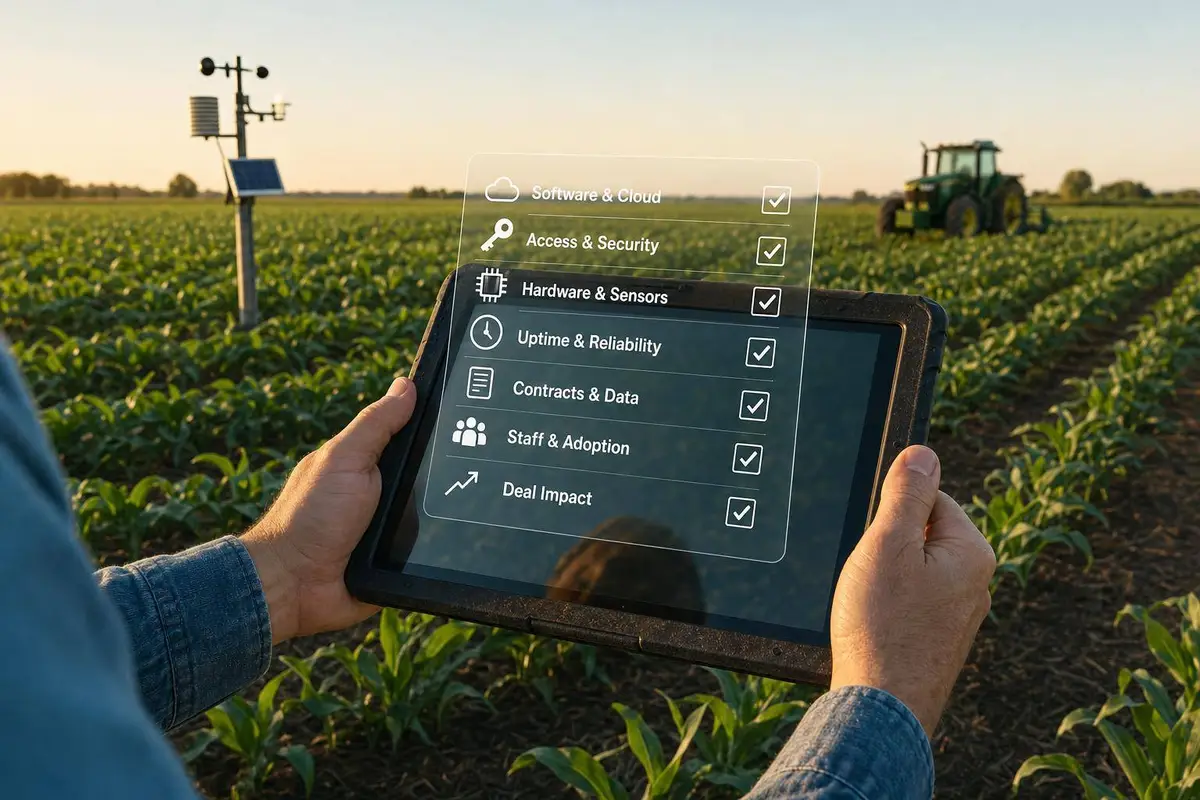
Here’s the short version of what I need to check before I get too far into diligence:
- Software stack: what systems run the business, who owns each account, and where data moves by hand
- Access controls: active users, MFA, backups, audit logs, and fast offboarding for seasonal staff and contractors
- Equipment and connectivity: hardware age, maintenance, calibration, dead zones, offline behavior, and sync delays
- Uptime and fallback plans: outage logs, support tickets, SLAs, and what the team does during planting, irrigation, or harvest if systems fail
- Contracts and data rights: assignment limits, change-of-control terms, renewals, price bumps, export rights, and post-termination access
- Staff adoption: login activity, field-level use, workflow coverage, training rates, and whether the seller is the only person who knows the system
- Deal impact: what should change price, lender terms, holdbacks, closing conditions, and the first 100 days
A few facts stand out. The article points to a case where a 3.0% trial yield lift fell to 0.3% on-farm. That gap shows why I can’t rely on trial claims alone. I also need source records - not seller-made spreadsheets - when I test users, hardware, maintenance, and usage.
My bottom line is simple: before close, I want proof that the systems are accessible, the data is usable, the contracts transfer, the equipment works in field conditions, and the team can run everything without the seller.
This checklist helps me turn those findings into deal terms instead of finding out after closing that the tech value was overstated.

AgriTech Due Diligence Checklist: 5 Key Areas Before Closing
📊 On-Farm Recordkeeping Strategies | Tools for Compliance & Business Success

sbb-itb-a3ef7c1
Software Stack Checklist: Systems, Integrations, and Access Controls
Start with the systems that keep production, labor, and reporting moving.
Inventory Every Business-Critical System in Use
Begin by listing every system the business relies on each day. In an agriculture SMB, that often means software for farm operations, irrigation, equipment management, inventory, accounting, compliance, and reporting.
For each system, confirm the vendor, the internal system owner, and whether the account sits with the business entity or with an individual owner. That detail matters more than it may seem at first. It tells you whether the company controls the account relationship, or whether the seller, a technician, or someone else still holds the keys.
Map Integrations and Manual Transfers
Trace how data moves from one system to another, including manual steps and fallback points. Look for every place where information is typed in by hand, moved through a spreadsheet, or sent by text or email.
Flag any workflow that would fail if one platform went down or if internet access dropped. Also note any data formats, permissions, or vendor terms that make exports hard or tie the business to one system or one person. If the business depends on manual re-entry, identify who handles it, what error checks exist, and who covers the task if that person is out.
Review User Access, Security, and Seasonal Workforce Controls
Seasonal labor makes access review part of day-to-day diligence. Agriculture SMBs often depend on seasonal employees, agronomy consultants, equipment vendors, and other third parties. That makes access control more than an IT task.
Verify that the business uses role-based access, multifactor authentication, audit logs, backups, and fast account removal across all critical systems.
Pull the user list and match it against payroll, contractor records, and source documents. Do not rely on a seller spreadsheet. Former employees or 1099 contractors with active access should be treated as a red flag, especially if they can still reach production systems, compliance records, or reporting tools. Confirm that access can be revoked, matches each worker’s status, and is controlled by the business entity.
Equipment and Uptime Checklist: Data Quality, Connectivity, and Reliability
After software and access controls, the next step is the hardware that keeps the operation running. Trial performance can look good on paper and still fall apart during peak season, especially in low-connectivity areas. So shift from software to the equipment that actually generates the operational data.
Confirm Hardware Inventory, Condition, and Data Output
Create your own hardware inventory from purchase invoices and maintenance logs, not from a seller-made spreadsheet. For each asset, note its age, condition, maintenance history, calibration history, and whether it has produced usable data across multiple seasons.
That last point matters more than it may seem. A short trial can tell one story, while field use tells another. In one case, a 3% trial yield lift dropped to 0.3% on-farm once environmental and management variables changed.
| Verification Item | Source Document / Action | Risk Mitigated |
|---|---|---|
| Asset Ownership | UCC-1 searches; title searches | Hidden liens or encumbered equipment |
| Equipment Condition | Physical inventory counts; maintenance log audit | Obsolete or non-functional hardware |
| Data Reliability | Comparison of trial data vs. on-farm output | Overstated efficacy or field-performance gap |
Check Connectivity Limits and Rural Failure Modes
Rural operations almost never have steady coverage across every field, barn, or irrigation zone. Ask the seller to map the dead spots and show what each system does when service drops. Does it store data locally? Sync later? Or just stop?
Those details matter most during the periods that drive revenue: planting, irrigation, and harvest. Document offline capability, sync delay tolerance, and any repeat failures tied to specific locations.
Review Uptime History, SLAs, and Manual Fallback Procedures
Request support tickets, outage logs, and uptime records for every SaaS platform, telematics portal, and irrigation management system. Pay close attention to incidents during peak seasonal windows, when downtime can turn into yield loss, missed applications, spoilage, or revenue disruption.
Also verify the outage procedures for field, irrigation, and harvest workflows. If the business doesn't have clear documentation, treat that as a continuity risk before close.
If the hardware checks out and uptime history holds up, the next step is the contracts that control data rights and service terms.
Contracts and Data Rights Checklist: Ownership, Portability, and Governance
After hardware and uptime, contracts are often where diligence gets messy. In AgriTech, service terms, data rights, and transfer limits can chip away at deal value after close. That’s why contract review matters: it tells you whether the systems mapped earlier can legally stay in place once the sale goes through.
Review Vendor Contracts for Data Control and Service Terms
Pull the original agreements for every mission-critical platform. That includes your Farm Management Information System (FMIS), telematics portals, irrigation management systems, and compliance or reporting software.
As you review them, look closely for terms that can create friction later:
- Assignment limits
- Change-of-control consent
- Auto-renewals
- Pricing escalators
- Minimum commitments
- Service suspension rights
- Third-party sharing limits
Once those transfer and service terms are clear, move to the next issue: who owns the data, and what the business can still export after close.
Verify Data Ownership and Export Rights
Check each contract and pin down who owns the data. Then confirm whether the business can access it, use it, export it, and keep it after a sale or termination.
| Vendor / Platform | Who Owns Data? | Portability / Export Rights | Third-Party Sharing Rights | Term & Termination | Post-Termination Data Access |
|---|---|---|---|---|---|
| FMIS | |||||
| Telematics Portal | |||||
| Irrigation Management System | |||||
| Compliance / Reporting Tool |
Complete this table using the actual contract language. Don’t guess, and don’t rely on sales promises. If the agreement is vague, that’s a red flag.
Assess Internal Governance and Diligence Organization
Contracts only tell part of the story. You also need to confirm that internal rules exist for data-access approval, retention, third-party sharing, and account handoff.
Make sure the business can still run if founders or key employees leave. That sounds basic, but it’s where a lot of teams get exposed. Approval rights, sharing rights, and offboarding steps should line up with the real user list, including seasonal workers and third-party contractors found in the access review above.
If the contract terms check out, the next step is simpler: find out whether staff use these tools enough to back up the valuation.
Adoption and Deal Summary Checklist: Staff Use, Value Impact, and Close Priorities
Measure Staff Adoption and Workflow Coverage
After contracts are signed and access is in place, usage is where the truth shows up. Paid licenses don't mean much on their own. What matters is whether people are logging in, using the system in daily work, and recording activity in a way that matches what happens in the field.
Start by comparing paid licenses with active logins and field logs. Skip the seller's spreadsheets. Pull usage data from source records, then check it against field records like spray logs and harvest records. If those logs are being backfilled by hand instead of recorded in real time, the system isn't operational. And if the logs don't line up with actual work, treat the system as unproven.
Talk to staff the seller didn't handpick. Field operators, herd managers, and nutritionists will usually tell you fast whether the data drives decisions or just sits there. One red flag stands out: owner-dependent data. If the seller is the only person with meaningful access or the only one who knows how the system works, the tech may lose most of its value the day that person leaves.
Use the table below to score each system before you lock in your findings:
| System Category | Adoption Level | Staff Trained (%) | Workflow Coverage | Data Quality Rating | Measured Impact on Yield/Cost |
|---|---|---|---|---|---|
| Precision Planting | |||||
| Spray/Chemical Logs | |||||
| Irrigation Sensors | |||||
| Livestock Monitoring | |||||
| Inventory/ERP |
If a system scores low on adoption or data quality, leave it out of EBITDA quality assessments. Put plainly, the claimed gains have not shown up in day-to-day operations, and a buyer shouldn't pay for benefits that exist only on paper.
Tie AgriTech Findings to Valuation, Financing, and Transition Risk
Once you know what people are using, convert those findings into price, financing terms, and close terms. Weak adoption, shaky integrations, uncalibrated sensors, and missing export rights all squeeze defensible EBITDA. They also give lenders a reason to question whether operating data is reliable or pieced together after the fact.
Material findings should move straight into the LOI and closing conditions. Retention agreements for key technical staff - the people who actually know how the systems run - should be conditions to closing, not post-close promises. If the seller's team hasn't adopted a system, set aside money and time for retraining in the transition plan and deal with it before close.
Conclusion: Core AgriTech Diligence Items to Verify Before Close
Use the checklist findings to shape closing conditions and first-100-day priorities. Before closing, confirm five things:
- The full software stack is mapped and accessible.
- Equipment data is real and calibrated.
- Uptime history and fallback procedures are documented.
- Contract and data rights transfer cleanly.
- Staff adoption is broad enough to keep operations running without the seller.
Those five items should directly shape your price, your structure, and your first 100 days as the new owner.
FAQs
How do I verify AgriTech claims?
Use an AgriTech SMB diligence checklist to keep the review focused and practical.
- Confirm the software stack, integrations, and system security/uptime.
- Inspect equipment, maintenance logs, and age/condition.
- Review contract assignability, change-of-control, licensing, permits, tax compliance, data ownership, and staff adoption.
It also helps to interview operators and technicians. That gives you a clearer read on key-person risk, whether processes are documented, and where training may be needed.
Clearly Acquired can help centralize and track these diligence items.
What AgriTech issues should change price?
Key diligence areas that can affect price include:
- Software stack: systems, integrations, licensing, and cybersecurity
- Equipment data: asset schedule, age and condition, and maintenance logs
- Uptime and operations: documentation, production records, and backup plans
- Contracts, data ownership, and staff adoption
Pull from source documents, not summaries, and review everything in a central deal hub.
How can I spot seller-dependent systems?
Look closely at how much the business depends on the seller for the software and IT stack, equipment maintenance, uptime support, contracts, and data governance.
Then check the people side. Watch for low staff adoption, thin cross-training, and too much reliance on a few key operators.
You’ll also want to review:
- Transferability
- Change-of-control terms
- Backup systems
- Transition plans
Those areas often expose operational risk fast.
Related Reading
Find the right lender for your business
Whether it's working capital, an SBA loan, or acquisition financing — we'll match you with the right capital partner.
About the author
Principal & CEO/CIO
Samson Jagoras has 15+ years across finance, real estate, and business acquisitions. He began his career as a Futures & Commodities broker and later served as Chief Strategy Officer of an INC 500 marketing and technology firm, helping scale revenue from $1M to over $100M. Today he buys, builds, and advises a portfolio of companies with a focus on M&A, capital allocation, and operational strategy.