United-American Merger: Pilot Union Praises Vision
Pilot union called United's merger pitch 'bold vision' while American rejected it amid antitrust and political opposition.
 Samson JagorasPrincipal & CEO/CIOMay 18, 2026

The proposed merger between United Airlines and American Airlines in early 2026 sparked intense debate. United CEO Scott Kirby pitched the idea as a way to create a stronger U.S. airline capable of competing with dominant foreign carriers. However, American Airlines CEO Robert Isom rejected the proposal outright, citing regulatory challenges and potential harm to employees and customers. The merger faced opposition from President Donald Trump and antitrust experts, making its approval highly unlikely.
Key Points
- Support: Allied Pilots Association President Nick Silva praised the proposal as bold, highlighting leadership issues at American Airlines.
- Opposition: American Airlines'' CEO and the White House dismissed the merger as anticompetitive.
- Challenges: Regulatory concerns included market overlap and potential route reductions affecting 40% of U.S. domestic capacity.
- Outcome: United Airlines dropped the idea by April 2026 after American Airlines refused to engage.
The merger''s failure underscored the complexities of airline consolidation and the need for leadership to address profitability gaps and competitive pressures.

1. Pilot Union Chief''s Perspective
Nick Silva, the President of the Allied Pilots Association (APA), voiced his support for United Airlines CEO Scott Kirby''s merger proposal. While American Airlines'' management dismissed the idea outright, Silva used the opportunity to spotlight what he sees as American''s long-term strategic missteps.
Strategic Rationale
Silva believes American Airlines has been lagging behind Delta and United in profitability for years, which he attributes to weak leadership. He sees Kirby''s merger proposal as an example of the bold and ambitious thinking American Airlines currently lacks.
"It''s clear that it will take bold ideas and real leadership to restore American to a true place of prominence among global airlines." — Nick Silva, President, Allied Pilots Association
Rather than rejecting the idea outright, Silva urged American Airlines'' board to explore strategic alternatives. His stance opens the door for broader discussions about the airline industry''s future.
Industry Impact
Silva suggested that the merger could reshape the landscape for airlines, passengers, and the communities they serve. He also tied the proposal to a larger issue: how American Airlines treats its workforce.
"(Kirby) articulated a bold vision for the future of air travel that could be transformative for our passengers, the communities we serve, and, foremost, the very people at American that our C-suite has chosen to disrespect: you." — Nick Silva, President, Allied Pilots Association
While the APA has stopped short of formally endorsing the merger, Silva''s comments highlight the potential of Kirby''s vision as a way to push for stronger leadership and better treatment of employees at American Airlines.
Antitrust Challenges
Silva acknowledged that the merger would face significant antitrust scrutiny, particularly in cities like Chicago where there is considerable market overlap. However, he noted that Kirby''s arguments suggest the merger could potentially overcome these regulatory barriers.
2. American Airlines CEO''s Rejection Stance
American Airlines CEO Robert Isom wasted no time in responding to United Airlines CEO Scott Kirby''s merger proposal — he flat-out rejected it. Instead of considering the strategic argument Kirby had presented to the Trump administration back in February 2026, Isom chose not to engage, effectively forcing United to drop the idea by late April 2026.
Strategic Rationale
"Merging the world''s two largest airlines together, that was a nonstarter from the get-go." — Robert Isom, CEO, American Airlines
He argued that such a merger would negatively impact American Airlines, particularly its employees and the overall customer experience.
Antitrust Challenges
While Kirby pitched the merger as an opportunity to transform the airline industry, Isom saw it as a regulatory nightmare. American and United already share considerable overlap at key hubs like Chicago O''Hare and various locations in Texas, which would likely draw intense scrutiny from regulators.
"At the end of the day there''s no way to view that as anything but anticompetitive, bad for customers, ultimately bad for American Airlines, bad for our team." — Robert Isom, CEO, American Airlines
Adding to the regulatory concerns was strong political resistance. President Donald Trump voiced his disapproval in April 2026, stating, "I don''t like having them merge." Kirby, acknowledging the growing opposition, remarked, "American''s public comments make it clear that a merger like this is off the table for the foreseeable future."
Ready to Make Your Next Move?
Whether you're buying, selling, or investing — Clearly Acquired gives you the tools, data, and support to close with confidence.
3. United Airlines CEO''s Proposal Initiative
In February 2026, Scott Kirby, the CEO of United Airlines, presented a bold merger proposal to American Airlines. His vision? To reshape the U.S. aviation landscape.
Strategic Rationale
Kirby''s proposal wasn''t about survival — it was about creating something greater. He saw the merger as a chance to build a stronger, more competitive airline, rather than cutting costs and reducing operations, which had been the norm for past airline mergers.
"In the past, airline mergers usually have been about two struggling airlines coming together to cut costs, flights and headcount. My aspirations could not be more different." — Scott Kirby, CEO, United Airlines
A key part of his argument was the need to challenge foreign carriers, which dominate approximately 65% of long-haul seats into the U.S., even though only 40% of those passengers are foreign citizens. A combined United-American entity, he believed, could level the playing field.
Industry Impact
The financial disparity between United and American Airlines highlighted the potential benefits of the merger. In the previous year, United reported a net income of $3.35 billion on $59 billion in revenue. In stark contrast, American Airlines earned just $111 million on $54.6 billion in revenue.
Operational Synergies
Kirby emphasized that the merger would allow the combined airline to expand its reach, particularly in smaller communities and international markets.
"I approached American about exploring a combination because I thought we could do something incredible for customers together." — Scott Kirby, CEO, United Airlines
Antitrust Challenges
Kirby acknowledged that regulatory hurdles could complicate the merger. Analysts pointed to potential antitrust issues on 289 routes, which could affect 40% of U.S. domestic capacity.
Pros and Cons
United vs. American Airlines: Merger Pros, Cons & Key Stats (2026)
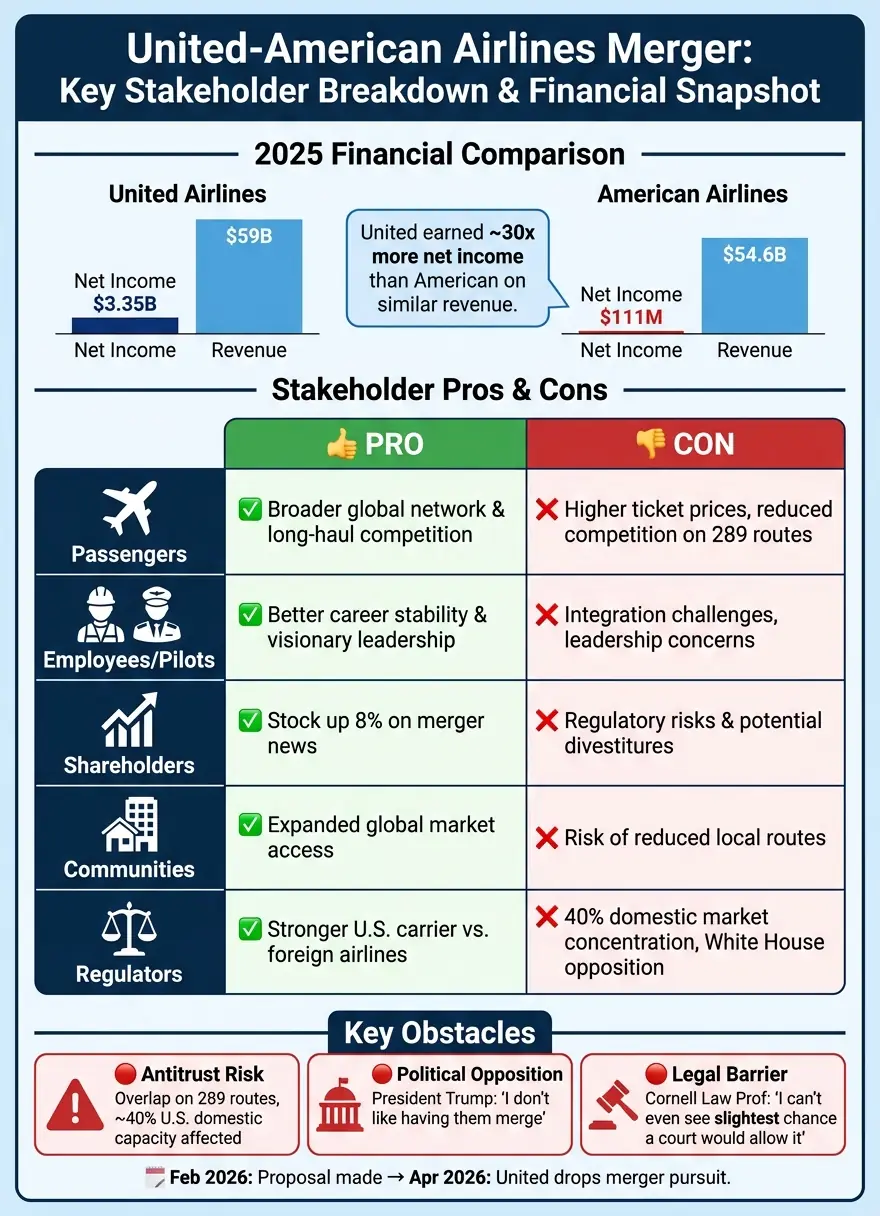
| Stakeholder | Pros | Cons |
|---|---|---|
| Passengers | Broader global network and stronger competition with foreign carriers on long-haul routes | Potential for higher ticket prices due to capacity control and reduced competition on 289 routes |
| Employees / Pilots | Promises of better career stability and visionary leadership | Integration challenges and concerns from American Airlines leadership about employee impact |
| Shareholders | Possible stock value growth — American Airlines shares climbed 8% after merger news | Significant regulatory risks and potential divestiture requirements |
| Communities | Expanded service strategies and improved access to global markets | Risk of reduced local route service if divestitures lead to cuts |
| Regulators | A major U.S. carrier capable of competing with foreign airlines | 40% domestic market concentration and political resistance from the White House |
From a consumer perspective, a larger airline could mean more destinations and competitive fares. However, history shows that consolidation often leads to higher ticket prices.
"This would be the biggest of all time. I can''t even see the slightest chance that a court would allow it." — George Hay, Law Professor, Cornell University
Even Kirby, one of the merger''s proponents, admitted the difficulties involved, stating, "mergers are big and hard and complicated."
Conclusion
The proposed merger between United and American Airlines faced significant challenges, despite its ambitious intentions. In 2025, American Airlines reported a net income of $111 million on $54.6 billion in revenue, while United earned $3.35 billion on $59 billion in revenue. This gap fueled skepticism from industry leaders and regulators alike.
Ultimately, the merger failed to gain traction due to strong opposition on multiple fronts. American Airlines CEO Robert Isom labeled the proposal as both anticompetitive and harmful to employees. Meanwhile, political resistance from the White House and legal analysis from a Cornell Law professor underscored the significant barriers to such a partnership.
In April 2026, United officially abandoned its pursuit of the merger after American Airlines declined to engage. While the deal never materialized, it cast a spotlight on American Airlines'' strategic vulnerabilities.
FAQs
Why did the pilot union chief support the merger idea?
The pilot union chief backed the merger idea, viewing United CEO Scott Kirby''s proposal as a display of bold vision. He felt it could reshape the airline industry in ways that would benefit passengers, communities, and American Airlines pilots.
What would regulators likely require to approve a United-American merger?
Regulators are likely to attach conditions aimed at tackling issues like competition, airport dominance, and the impact on consumers. These could include divestment of routes or airport slots, pricing restrictions, commitments to preserve competition in key markets, and ongoing monitoring to guard against monopolistic behavior.
How could a merger change ticket prices and routes for U.S. travelers?
A merger between United Airlines and American Airlines has the potential to shake up ticket prices and travel routes. Fewer competitors on certain routes could mean higher fares, while a combined network might streamline operations and open up more direct flight options. Critics warn that reduced competition — especially on overlapping routes — could result in rising ticket costs.
About the author
Principal & CEO/CIO
Samson Jagoras has 15+ years across finance, real estate, and business acquisitions. He began his career as a Futures & Commodities broker and later served as Chief Strategy Officer of an INC 500 marketing and technology firm, helping scale revenue from $1M to over $100M. Today he buys, builds, and advises a portfolio of companies with a focus on M&A, capital allocation, and operational strategy.