SBA Loan Reporting Requirements & Timeline
After closing, an SBA loan starts a steady reporting cycle: annual and interim financials, guarantor forms, the new bank-statement rule, DSCR checks, 504 occupancy proof, and key deadlines.
 Samson JagorasPrincipal & CEO/CIOJune 27, 2026
Get matched with the right lender for your business
Compare offers from our vetted network. Pre-qualify in minutes — no impact to your credit.
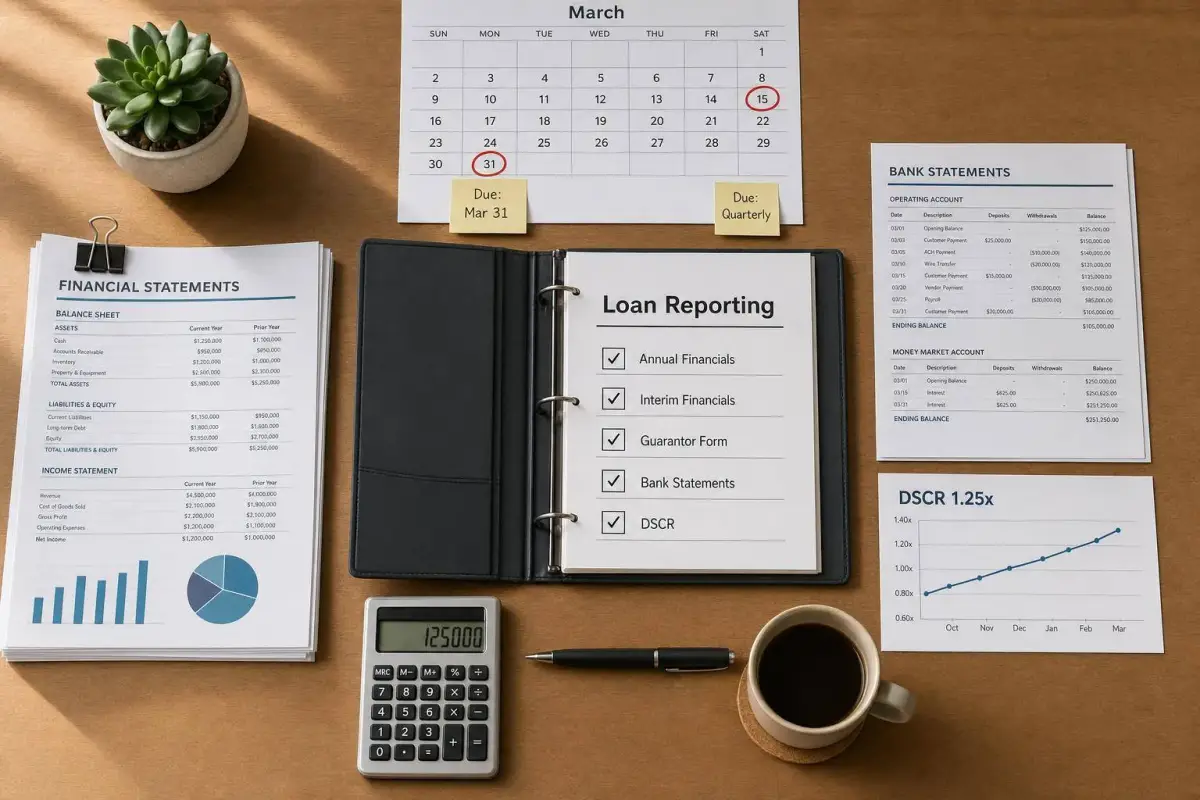
Getting an SBA loan funded is not the finish line. It starts a steady reporting cycle that can last for the life of the loan.
If I had to sum this up in one line, it would be this: after closing, I need to keep sending my lender updated financials, tax returns, bank statements, insurance proof, and owner information on time. If I miss deadlines or send numbers that do not match, the lender may step up monitoring, pause requests, or flag the file.
Here’s the short version:
- Annual reports: business tax returns, year-end financial statements, and guarantor tax returns
- Interim reports: often quarterly P&L and balance sheet, and sometimes monthly reports in Year 1
- Owner reporting: owners with 20%+ ownership usually need an updated SBA Form 413
- Bank statement rule: as of March 1, 2026, lenders must collect the 2 most recent months of business bank statements for DSCR review
- Common ratio check: many lenders want a DSCR of at least 1.25x
- SBA 7(a) and 504 loan extra step: yearly occupancy proof for 51% of an existing building or 60% of new construction
- Early post-close item: SBA Form 1050 and proof of equity injection are often due within 45 days
What matters most is simple: send clean numbers, send them on time, and keep support documents easy to verify. That makes lender reviews smoother and can help if I later want more financing, a refinance, or a line increase.
The rest of this article breaks down what usually gets requested, when it is due, what can trigger extra requests, and how I’d stay ready without scrambling.
The Comprehensive Guide to SBA 7(a) Loans [2026]

Core Financial Reporting Requirements for SBA 7(a) and 504 Loans
The reporting package usually starts with the business, then moves to the guarantors, and then to any items tied to collateral. Put simply, lenders use these filings to keep tabs on repayment ability, covenant compliance, and the condition of the collateral.
Business Financial Statements and Tax Returns
Your annual reporting package usually includes your federal business tax returns with all schedules, a year-end balance sheet, an income statement, and a cash flow statement. If your business is an S corporation or partnership, K-1s are also required to confirm income flow and ownership percentages.
Most lenders want this package within 90 to 120 days after your fiscal year-end. They also often ask for quarterly or monthly year-to-date interim financials, usually a profit and loss statement and balance sheet, so they can monitor performance between annual reviews.
Lenders usually prefer financials prepared on an accrual basis, especially if the business has more than $2 million in revenue. Why? Accrual accounting tends to show a clearer picture of the company’s financial condition.
As of March 1, 2026, SBA lenders must obtain the two most recent months of commercial bank statements for the borrower’s main operating account and match them to the DSCR calculation.
Guarantor Reporting and Supporting Documents
Any owner with 20% or more ownership must submit an updated Personal Financial Statement (SBA Form 413) each year. Lenders also require signed personal federal tax returns, including all schedules and K-1s.
You should also expect to provide a few documents tied to collateral:
- Insurance certificates for hazard, flood, and life insurance, along with assignment documents, at each policy renewal
- Property tax receipts and rent rolls if real estate secures the loan
- Proof of current life insurance premiums for loans that include a life insurance assignment
Some lenders also use IRS Form 4506-C to request official tax transcripts straight from the IRS and check them against the information you submitted.
How Reporting Differs Between 7(a) and 504 Loans
Once the standard reporting package is in place, the loan type shapes the extra reporting requirements. The main difference is the occupancy certification tied to 504 loans.
504 financing is meant for owner-occupied commercial real estate. Because of that, the CDC must confirm each year that your business still uses the required share of the property: 51% for existing buildings or 60% for new construction.
That rule usually does not apply to standard 7(a) loans unless real estate is part of the deal.
Reporting Timelines, Deadlines, and Common Covenant Triggers

Once the document list is set, timing becomes the next place things can go off track. Post-close reporting is mostly about staying on top of dates and keeping your paperwork clean.
What to Submit Right After Closing and During Year One
Within 45 days of closing, you need to submit SBA Form 1050 to certify use of proceeds, along with any required equity injection documentation. For acquisition loans, lenders also confirm where the equity came from before they release the final disbursement. That usually means bank statements, gift letters, or records from an asset sale.
If the loan includes construction or equipment purchases, some funds are often placed in escrow. Those funds are released only after you submit invoices or meet stated project milestones. So in Year One, your reporting schedule may follow project stages instead of fixed calendar dates.
During the first 12 months, expect more lender check-ins than you will later on. It’s common for lenders to ask for monthly expense reports on working capital loans, plus monthly bank statements so they can compare actual cash flow against the DSCR calculation.
Annual Deadlines and Interim Reporting Cadences
After Year One, reporting usually shifts to an annual cycle. Lenders often require a full annual package by a set deadline, and the financial statements need to match the filed tax returns.
Between those annual submissions, many lenders also ask for interim financials, often on a quarterly basis. In many cases, those reports need to be updated within the last 90 to 120 days. Even if quarterly reporting is not spelled out in the loan agreement, sending it on your own can help keep your file current and make later reviews easier.
Calendar deadlines are just the starting point. Covenants can trigger extra reporting at any time.
Common Covenants and Events That Trigger Extra Reporting
Outside the normal reporting calendar, certain events or loan terms can lead to more requests from the lender. Debt-ratio covenants are common. If you miss payments, change ownership, take on new debt, change collateral, or miss a required ratio, the lender may ask for added reporting.
Other triggers often include ownership changes, insurance renewals, major equipment purchases, missed projections, and updated personal financial statements for owners with 20% or more ownership.
Use the schedule below as your post-close reporting calendar:
| Timing | Key Reporting Items | Notes |
|---|---|---|
| Immediately Post-Close (0–45 days) | SBA Form 1050, proof of equity injection, invoices for disbursement | Required to verify that proceeds match the Authorization and to clear final disbursement conditions |
| Monthly (Year 1) | Two most recent months of commercial bank statements, expense reports, YTD P&L | Required for working capital oversight and DSCR reconciliation |
| Quarterly | Interim P&L and balance sheet | Often requested for covenant monitoring; helpful for keeping the lender relationship current |
| Annually | Full federal tax returns with all schedules, annual financial statements, updated guarantor statements | Financials must match the filed returns |
| As needed | Updated appraisals, environmental reports, revised use of proceeds, insurance renewals, ownership change notices | Triggered by covenant or collateral changes, major equipment purchases, real estate changes, or missed projections |
| Every six months in default | Written loan status reports to the CLSC | Required after guaranty purchase; initial report due within 15 business days of notice |
How Lenders, CDCs, and Credit Reporting Use Your Financial Data
Once you know what to send, the next step is knowing where it goes and how lenders put it to work. Your post-close reports shape servicing decisions, covenant checks, and credit reporting.
How Your Financials Move from Borrower to Lender to SBA
When you send financials to your lender or CDC, they review them to judge risk, track covenant compliance, and meet servicing rules. The SBA requires lenders to keep a permanent loan file, update the loan record in E-Tran, and report monthly payment activity through SBA Form 1502. Lenders also have to collect the two most recent months of commercial bank statements and match them against cash flow and debt service.
This is where the paperwork starts to feel less like admin work and more like a loan checkup. Your lender isn’t just filing documents away. They’re comparing what your business says on paper with what your bank activity shows in practice.
How Loan Health Affects Your Business Credit File
That same information can shape how your business shows up with commercial credit bureaus. Payment performance on your SBA loan is reported to those bureaus, and that can affect future access to acquisition financing, including a working capital line, equipment financing, or financing for a future acquisition.
In plain English: if your loan history looks clean, future borrowing tends to get easier. If it looks messy, lenders notice.
What Late or Incomplete Reporting Can Lead To
Late reporting can create friction with your lender fast. They may increase monitoring, restrict owner distributions, or require covenant waivers before approving changes to the loan. If your financial statements don’t line up with your tax returns, lenders treat that as a red flag, and it can delay modifications or future credit requests.
Late or incomplete reporting can also chip away at lender confidence. And once that trust slips, even small requests can take longer than they should.
Here’s the simplest way to follow each report from borrower to lender to SBA.
| Source | Information | Destination | Purpose |
|---|---|---|---|
| Borrower | Interim Financials (P&L, Balance Sheet) | Lender / CDC | Monitor loan covenants, including DSCR, and assess ongoing business risk |
| Borrower | Annual Tax Returns | Lender / CDC | Verify historical profitability and ensure consistency with internal records |
| Borrower | 2 Months of Bank Statements | Lender | Reconcile DSCR and identify undisclosed short-term debt, such as merchant cash advances |
| Borrower | Use of Proceeds Documentation | Lender / CDC | Confirm funds were used for authorized purposes |
| Lender / CDC | SBA Form 1502 (Payment Status) | SBA | Maintain the federal guaranty and report on program-wide loan performance |
| Lender | Payment Performance Data | Commercial Credit Bureaus | Build the business’s credit file and affect future borrowing capacity |
Best Practices for Staying Lender-Ready After SBA Loan Approval
Once you know what the lender expects, the next step is simple: build a system you can repeat every month. Staying lender-ready comes down to making reporting part of your normal routine, not a last-minute fire drill.
Build a Monthly Close and Document Calendar
Start with a monthly close process that lines up with the numbers your lender may review later. Within 24 hours of month-end, reconcile bank accounts, credit cards, and loan accounts. Review AR and AP aging schedules too, and flag anything that doesn’t make sense before the lender asks about it.
Then look past the month-to-month cycle. Set reminders for annual tax return prep, insurance renewals, and year-end financial close. A plain calendar works fine. The point is to avoid gaps now instead of trying to explain them later.
Keep Financials Accurate and Easy to Verify
The most common source of servicing delays is a mismatch between internal financial statements and filed tax returns. If your year-to-date P&L says one thing and your IRS filing says another, covenant reviews and future credit requests can slow down fast.
Keep a live debt schedule for every obligation, including equipment leases and lines of credit. It should track:
- original balances
- current balances
- monthly payments
- interest rates
- maturity dates
A rolling 13-week cash flow projection can also help you spot liquidity gaps before they become lender problems. And don’t mix personal and business expenses. Lenders need a clean line between business activity and personal draws.
Use the same file naming format for every document you send, and keep everything in one secure, organized digital folder. If results change in a big way, have a short management narrative ready to explain the variance. That kind of fast, organized response cuts down on lender follow-up.
The goal isn’t just clean books. It’s being able to produce fast, defensible reporting the moment a lender asks for support.
Use Integrated Systems to Support Ongoing Reporting
Teams that keep deal documents, financial packages, and post-close reporting in one place spend a lot less time scrambling when a lender request shows up. Clearly Acquired is built for exactly this — giving acquisition entrepreneurs a single ecosystem to organize lender-ready materials alongside deal flow and capital management.
Use this checklist to assign ownership and set the right cadence:
| Practice | Owner | Frequency | Why It Matters |
|---|---|---|---|
| Bank & Loan Reconciliation | Controller / Bookkeeper | Monthly | Ensures the general ledger matches actual bank and debt activity; required for SBA DSCR verification |
| AR/AP Aging Review | Controller / Owner | Monthly | Identifies collection issues or vendor stress that signal cash flow gaps |
| Covenant Tracking (DSCR) | CFO / Controller | Quarterly | Ensures the business stays above the 1.25x DSCR threshold |
| Tax-to-Book Reconciliation | CPA / Controller | Annually | Prevents discrepancies between P&L and tax returns — a primary audit red flag |
| Insurance & Document Audit | Admin / Owner | Annually | Confirms required hazard, flood, or life insurance policies remain active |
FAQs
What happens if I miss a reporting deadline?
Missing an SBA loan reporting or paperwork deadline can cause real problems.
For borrowers, there’s a hard clock on closing. If you don’t sign and return the closing documents within the required 30- to 60-day window, the loan approval can be voided.
For lenders, missed deadlines around SBA-purchased loans or 1502 reporting can make resolution harder, lead to late penalties, and hurt future eligibility.
If a delay looks likely, contact your lender or the right SBA center right away.
How do lenders calculate DSCR?
Lenders calculate DSCR by dividing a business’s net operating income by its total annual debt service.
In most cases, they start with net income from the profit and loss statement. Then they add back interest, depreciation, and amortization. Some lenders also add back one-time or non-recurring expenses.
Total annual debt service includes all principal and interest payments for both existing debt and any new debt the business wants to take on.
What documents should I keep ready year-round?
Keep key legal, loan, and money records in one place and easy to find all year. That includes IRS tax transcripts, insurance policies, signed closing documents, and proof of how money was used, like invoices, receipts, and project completion documents.
You should also keep current financial records up to date. This includes year-to-date profit and loss statements, balance sheets, aging reports, debt schedules, payment records, and business bank statements.
Find the right lender for your business
Whether it's working capital, an SBA loan, or acquisition financing — we'll match you with the right capital partner.
About the author
Principal & CEO/CIO
Samson Jagoras has 15+ years across finance, real estate, and business acquisitions. He began his career as a Futures & Commodities broker and later served as Chief Strategy Officer of an INC 500 marketing and technology firm, helping scale revenue from $1M to over $100M. Today he buys, builds, and advises a portfolio of companies with a focus on M&A, capital allocation, and operational strategy.