SBA $10M Loan Limit: How 7(a) and 504 Stacking Works Under the New Rules
Effective July 4, 2026, the SBA doubled the cumulative 7(a) and 504 cap to $10M. Borrowers can stack $5M 7(a) + $5M 504 — here's eligibility, sequencing, and structuring guidance.
 Samson JagorasPrincipal & CEO/CIOMay 26, 2026

Get matched with the right lender for your business
Compare offers from our vetted network. Pre-qualify in minutes — no impact to your credit.
Effective July 4, 2026, the Small Business Administration (SBA) has doubled the cumulative 7(a) and 504 loan limit to a historic $10 million.
Starting July 4, 2026, small business owners can access up to $10 million in SBA-backed loans. The 7(a) and 504 programs now each have independent $5 million caps, offering expanded financing options for acquisitions, real estate, and equipment.
Key Changes
- New Limit: Borrowers can combine $5M from 7(a) loans with $5M from 504 loans.
- Decoupled Caps: 7(a) and 504 loans no longer reduce each other's borrowing capacity.
- Eligibility: Focused on U.S. citizens and industries like manufacturing, logistics, and construction.
- Use Cases: 7(a) loans cover goodwill and working capital, while 504 loans finance real estate and equipment.
This update simplifies financing for larger projects, but eligibility rules and timelines remain critical considerations.
SBA 7a & 504 10M Stacking: The Decoupling Rule That Changes Everything

What Changed on July 4, 2026?
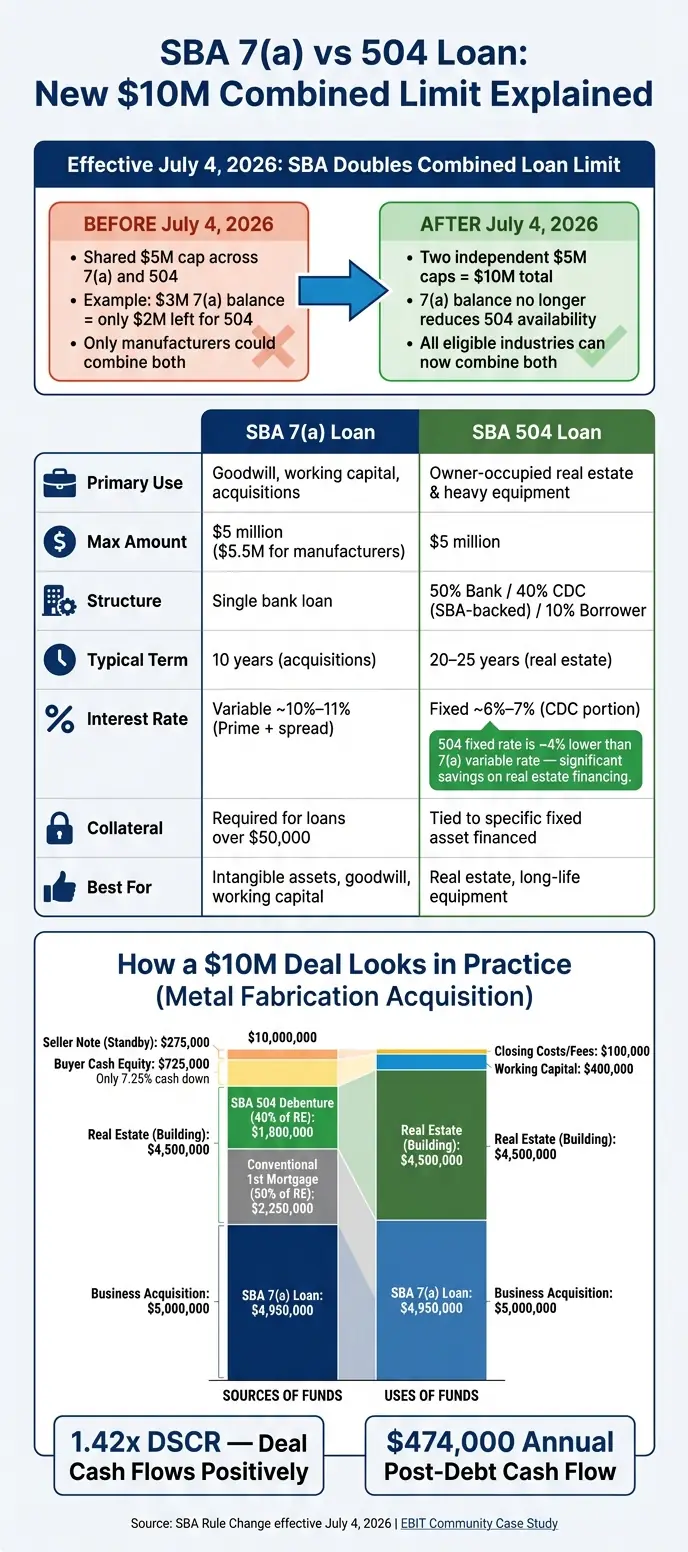
SBA 7(a) vs 504 Loan: New $10M Combined Limit Explained
Before July 4, 2026, the SBA's $3 million 7(a) loan balance left borrowers with only $2 million available between the 7(a) and 504 programs combined. This limitation often made financing larger real estate transactions challenging.
The New $10 Million Cumulative Limit
The major update is this: the cumulative SBA-backed financing limit doubled to $10 million. Borrowers can now access up to $5 million from the 7(a) program while separately securing an additional $5 million through the 504 program.
"Decoupling replaces one shared $5M ceiling with two independent $5M limits that no longer count against each other." — Jason Hunt, EBIT Community
This shift not only increases the total financing available but also allows borrowers to stack capital more strategically for larger, more complex acquisitions.
It's important to note that the $10 million limit applies only to the SBA-backed portion of the financing, not the total project cost. For example, the 504 program includes a conventional bank first mortgage, which isn't SBA-backed. Under the 504 program's typical 50/40/10 structure — where the SBA backs only 40% of the project — a deal could reach a total value of approximately $12.5 million.
Previously, only manufacturers could combine 504 financing with a fully utilized 7(a) loan. Now, this opportunity is open to all eligible industries, including construction, logistics, energy, and food production. This broader access highlights the importance of understanding SBA 7(a) loan terms vs. other financing options like the 504 program.
Key Differences Between 7(a) and 504 Loans
To make the most of the updated limits, it's crucial to understand how these two loan programs differ. Each serves a specific purpose, and choosing the right one — or a combination of both — can significantly impact your financing strategy and costs.
| Feature | SBA 7(a) Loan | SBA 504 Loan |
|---|---|---|
| Primary Use | Goodwill, working capital, acquisitions | Owner-occupied real estate and heavy equipment |
| Max Amount | $5 million | $5 million ($5.5M for manufacturers) |
| Structure | Single loan from a bank | 50% Bank / 40% CDC (SBA-backed) / 10% Borrower |
| Typical Term | 10 years for acquisitions | 20–25 years for real estate |
| Interest Rate | Variable (Prime + spread, ~10%–11%) | Fixed on CDC portion, ~6%–7%; variable on bank portion |
| Collateral | Required for loans over $50,000 | Tied to the specific fixed asset being financed |
One key distinction is the interest rate. The 504 program's fixed CDC rate — currently around 6%–7% — is significantly lower than the 7(a) program's variable rate of about 10%–11%. For deals involving real estate, using the 504 program for that portion is often not just a better structural fit but also a way to save on costs.
How 7(a) and 504 Loan Stacking Works Under the New Rules
The latest rules redefine how businesses can leverage SBA 7(a) and 504 loans together. As of July 4, 2026, the key change is decoupling: an outstanding balance on one loan no longer affects the available balance on the other. Each program now has its own independent $5 million borrowing limit.
Eligibility and Sequencing Rules
The SBA emphasizes the importance of following the right sequence: start with the 7(a) loan. This loan acts as the foundation for the financing structure, with the 504 loan added on top.
"The 7(a) anchors the structure and the 504 stacks onto it. Build the deal in that order." — Jason Hunt, Author, EBIT Community
The purpose of each loan also matters. The 7(a) loan is ideal for intangible assets like goodwill, working capital, and inventory. Meanwhile, the 504 loan should focus on fixed assets such as owner-occupied real estate and long-term equipment. This division isn't just practical; it ensures you maximize the borrowing potential of both programs.
Borrowers can also use refinancing to reset their 7(a) balance strategically. If at least 75% of a previous 7(a) loan was used for fixed assets, that loan can be refinanced into a 504. Heather Endresen, Founder of Viso Business Capital, explains:
"If you used an SBA 7a loan to acquire a business, and at least 75% of the loan proceeds were used for long-term equipment and/or CRE in that deal, you could refi it into 504, and free up your 7a runway for another deal."
This approach effectively resets the $5 million 7(a) limit, allowing businesses to pursue additional acquisitions or projects.
Practical Examples of Combining Both Loans
A case study from EBIT Community in 2026 shows how these rules work in real-world scenarios. In one example, a buyer acquired a metal fabrication business with $1.6 million in adjusted EBITDA for a total project cost of $10,000,000. The breakdown looked like this:
| Use of Funds | Amount | Source of Funds | Amount |
|---|---|---|---|
| Business Acquisition | $5,000,000 | SBA 7(a) Loan | $4,950,000 |
| Real Estate (Building) | $4,500,000 | Conventional 1st Mortgage (50%) | $2,250,000 |
| Working Capital | $400,000 | SBA 504 Debenture (40%) | $1,800,000 |
| Closing Costs/Fees | $100,000 | Buyer Cash Equity (7(a) + 504) | $725,000 |
| Seller Note (Standby) | $275,000 | ||
| Total Uses | $10,000,000 | Total Sources | $10,000,000 |
With just $725,000 in cash — about 7.25% of the total deal — the buyer achieved a 1.42x DSCR, generating $474,000 in annual post-debt cash flow. This type of structure was impossible under the old combined $5 million cap.
That said, borrowers should plan for a longer timeline. Combining 7(a) and 504 loans typically takes 90 to 120 days to close, compared to 60 to 75 days for a 7(a)-only deal. The extended timeline accounts for the involvement of both a bank and a Certified Development Company (CDC).
Who Qualifies for the Expanded Limit?
With the historic $10 million limit in place, the program now enforces stricter eligibility rules to ensure the most qualified borrowers benefit. Understanding these tightened requirements early can save both time and money. You can also use an SBA loan interest calculator to estimate your potential debt service obligations under these new limits.
SBA Eligibility Criteria
A major new requirement took effect on March 1, 2026: every owner, partner, and member of any holding company or trust connected to the business must be a 100% U.S. citizen or U.S. national. Green-card holders no longer qualify, and there are no exceptions for minority ownership. Any non-citizen ownership automatically results in a decline. This change alone caused an 18% drop in SBA 7(a) lending during the first five months of FY 2026.
Borrowers must also meet a minimum Debt Service Coverage Ratio (DSCR) of 1.10x. Additionally, the 504 program remains focused on owner-occupied real estate and long-life equipment, making it inaccessible for businesses heavily reliant on goodwill, like professional services firms without significant real estate or equipment.
"If your deal is primarily backed by goodwill with no significant real estate or equipment, you will still be limited to a maximum SBA 7(a) exposure of $5 million." — Brad Hettich, President, Commercial Lending X
The new rules favor manufacturers, offering them extra benefits. Businesses with NAICS codes 31–33 qualify for a higher 504 project limit of $5.5 million, reduced upfront guarantee fees, and 90% loan guarantees on 7(a) loans. Another new feature, the "90% Grocery Guarantee," supports small businesses in the food supply chain.
The SBA also evaluates cumulative exposure across affiliated businesses, adding another layer of scrutiny.
Borrower-Level and Affiliate-Level Limits
The $10 million cap applies across all affiliated businesses within the same industry subsector. The SBA uses the first three digits of the NAICS code to track exposure. Businesses with matching codes share the $10 million limit, while those with different codes qualify separately.
This creates opportunities for serial acquirers. For instance, a borrower owning a food manufacturing company (NAICS 311) and a wholesale distribution business (NAICS 424) could access $5 million in 7(a) financing for each entity, as they belong to different industry subsectors. However, the SBA's maximum guarantee for any single borrower remains $3.75 million per program, which aligns with the $5 million loan cap at a 75% guarantee rate.
Past SBA loan history is also under scrutiny. Lenders now perform detailed checks on records from previous EIDL and PPP loans. This heightened oversight stems from the SBA referring about $22 billion in suspected pandemic-related fraud (involving 560,000 borrowers) for enforcement. Before applying, ensure all prior SBA loans are properly documented, forgiven, or fully repaid.
Structuring Larger Acquisitions with the New Limits
The increased loan limit opens up more options for structuring larger acquisitions. The key is understanding how to use both the 7(a) and 504 programs effectively — not as one combined loan, but as two separate tools. This distinction can make the difference between a well-structured deal and a missed opportunity.
Building the Right Capital Stack
The new $10 million limit is not a single loan — it's two separate programs that work together. Structuring them correctly can help eliminate capital constraints.
Here's the critical sequence: start with the 7(a) loan, then layer the 504 loan on top. The 7(a) loan is essential for financing intangible assets like goodwill, working capital, inventory, and closing costs. Meanwhile, the 504 loan is designed for fixed assets such as owner-occupied real estate and long-life equipment. Reversing this order can jeopardize the deal's success.
To size a stacked structure for your deal, compare SBA 7(a) and 504 financing options through Clearly Acquired's lender network.
Borrowers who previously used a 7(a) loan for acquisitions focused on long-term assets have a unique refinancing opportunity:
"There's an interesting refi play here too. If you used an SBA 7a loan to acquire a business, and at least 75% of the loan proceeds were used for long-term equipment and/or CRE in that deal, you could refi it into 504, and free up your 7a runway for another deal." — Heather Endresen, Founder, Viso Business Capital
On the equity side, 7(a) loans offer flexibility. Buyers may contribute as little as 5% in cash, with the remaining equity injection (up to 10%) coming from a seller note on full standby (no principal or interest payments during the SBA loan term). In contrast, the 504 program often requires a full 10% cash injection, with higher requirements for specialized properties like hotels or car washes.
Another structural benefit is that the 504's $5 million limit applies only to the CDC debenture, which covers 40% of the project. The bank's 50% first mortgage isn't subject to the SBA guarantee. This means real estate projects can exceed $12.5 million while keeping the full $5 million 7(a) capacity intact for other acquisitions.
"The $5 million 504 limit sounds like a $5 million ceiling, but the two loan structure means the actual project ceiling is $12.5 million or more on the 504 side alone." — Brad Hettich, President, Commercial Lending X
Keep in mind, combined deals typically take longer to close due to dual underwriting processes.
Once the capital stack is structured, the next step is to assign the right financing program to each part of the deal.
Matching Deal Needs to the Right Loan Program
Aligning each deal component with the most suitable loan program ensures a cleaner capital structure and helps control costs.
| Deal Need | Recommended Program | Rationale |
|---|---|---|
| Goodwill / Intangibles | 7(a) | 504 loans cannot finance intangible assets like goodwill |
| Working Capital | 7(a) | 504 loans are limited to fixed assets |
| Owner-Occupied Real Estate | 504 | Provides long-term, fixed-rate financing while preserving 7(a) capacity |
| Heavy Equipment (10+ year life) | 504 | Typically offers lower fixed rates compared to variable 7(a) rates |
| Inventory / Short-term Assets | 7(a) | 504 loans cannot fund operational or short-term assets |
| Refinancing Prior 7(a) Debt | 504 | Frees up 7(a) capacity for future acquisitions |
| Closing Costs | 7(a) | Can be rolled into the 7(a) loan proceeds |
If real estate isn't part of the initial acquisition, consider negotiating a first right of refusal (ROFR) or purchase option in the lease. This allows you to use a 504 loan later when you're ready to buy the property.
Key Considerations Before Using the Full $10 Million
While reaching the new $10 million SBA loan ceiling is achievable, it's not automatic. There are several potential hurdles that can derail your plans if you don't address them upfront. These factors serve as critical checkpoints as you map out your acquisition strategy.
Program Constraints to Know
Using the full $10 million cap requires careful coordination of the 7(a) and 504 loan programs. Here's the catch: the 7(a) loan cap remains at $5 million, and the 504 loan is limited to specific fixed assets. This means the 504 portion can only be applied to owner-occupied real estate (with at least 51% occupancy) or long-term equipment. If your acquisition leans heavily on goodwill or working capital, the 504 loan won't help — you're effectively capped at $5 million.
Timing is another factor to consider. Blended deals that combine 7(a) and 504 loans typically take 90–120 days to close. The 504 debenture process, tied to monthly bond cycles, adds an extra 30–45 days to the timeline. If your deal has a firm closing deadline, this extended process might not work for you.
Equity injection requirements also vary by program. For 7(a) loans, up to 5% of the required equity can be covered by a seller note. However, the 504 program generally requires 10% in cash. This increases to 15% when purchasing real estate alongside a business change of ownership. If the property is considered "special-purpose" (e.g., car washes or self-storage), the requirement can jump to 20%.
Lastly, citizenship requirements must align with SBA eligibility rules. For more details, refer to the "Who Qualifies for the Expanded Limit?" section.
"The SBA did not loosen its underwriting. It expanded its ceiling. The deals that close in 2026 are still the deals that are structured correctly from the start." — Brad Hettich, President, Commercial Lending X
Working with Lenders and CDCs
Understanding the program constraints is just the beginning. To successfully close a combined deal, you'll need seamless coordination with lenders and Certified Development Companies (CDCs). Each party operates independently, with separate underwriting processes, timelines, and documentation requirements. To avoid delays, start coordinating with both lenders from day one.
Not all lenders are prepared for the new $10 million combined structures. Some banks haven't updated their internal credit policies to accommodate this increased exposure. Before diving into a deal, ask your lender upfront if they are actively quoting combined structures under the updated rules.
"The wrong bank says 'we can't do that,' not because the SBA forbids it, but because its playbook has not caught up." — Jason Hunt, Author, EBIT Community
Partnering with a Preferred Lender Program (PLP) member can save you valuable time. PLP lenders can make final credit decisions in-house, bypassing the need for SBA headquarters approval and cutting weeks off the process. To avoid delays, submit a complete package upfront, including three years of personal and business tax returns, personal financial statements, resumes, and a business plan. Incomplete submissions often slow things down.
Additionally, confirm that your bank can provide an interim first mortgage to bridge the financing gap before the 504 debenture funds are released. Since 504 proceeds are only disbursed after project completion, having this interim financing in place is critical to keeping your deal on track.
Conclusion: How to Make the Most of the New $10 Million SBA Limit
The July 4, 2026 rule change stands as a major milestone in the history of SBA lending, offering entrepreneurs unprecedented flexibility. Instead of being confined by a single shared $5 million limit, borrowers now have two independent $5 million ceilings. This creates opportunities to handle larger and more intricate deals.
To make the most of this expanded capacity, savvy borrowers combine the strengths of the 7(a) and 504 loan programs. The 7(a) loan is ideal for goodwill, working capital, and inventory, while the 504 loan is better suited for owner-occupied real estate and heavy equipment. By using the programs strategically, borrowers can preserve their 7(a) capacity for future acquisitions while fully utilizing the new $10 million limit.
For those looking to maximize their financing options, there are two advanced strategies worth considering:
- Refinance Strategy: If at least 75% of your original 7(a) loan was used for fixed assets, refinancing into a 504 loan can reset your 7(a) capacity, giving you room for additional funding.
- NAICS Code Strategy: Acquiring businesses in different NAICS sectors allows you to take advantage of separate $5 million 7(a) limits for each sector.
"By doubling the combined loan limits of SBA's 7(a) and 504 loans, this Administration is empowering job creators... to invest in American workers, rebuild our industrial strength, and grow the small business economy." — Kelly Loeffler, Administrator, U.S. Small Business Administration
FAQs
Can I use the full $10 million for one purchase?
Yes, you can use the combined $10 million in SBA-backed financing for a single purchase. Starting July 4, 2026, eligible borrowers will be able to combine up to $5 million in 7(a) financing with $5 million in 504 financing. However, the 7(a) loan must be secured first. Since the 504 loan only covers a portion of real estate and equipment costs, the total project size can go beyond $10 million.
What's the fastest way to close a combined 7(a) and 504 deal?
Closing a combined 7(a) and 504 loan deal usually takes between 90 and 120 days, mainly because of its complexity. To speed things up, it's smart to secure the 7(a) loan first. This loan essentially serves as the foundation for the overall structure, making it easier to integrate the 504 loan afterward.
Since this process involves two key players — your bank for the 7(a) loan and a Certified Development Company (CDC) for the 504 loan — your choice of CDC can make a big difference. Opt for a CDC with plenty of experience and strong communication skills to help avoid unnecessary delays.
How do SBA affiliation and NAICS codes affect my $10 million limit?
SBA affiliation rules help determine whether businesses are considered to be under common control. If they are, their combined debt might count toward your loan limit. Here's how it works: the $10 million cap applies to each NAICS code. This means businesses operating in entirely different industries — identified by NAICS codes with different first three digits — could each qualify for up to $5 million through 7(a) and 504 loans. However, businesses sharing NAICS subsectors are typically grouped together, and their combined debt counts toward the shared $10 million limit.
Find the right lender for your business
Whether it's working capital, an SBA loan, or acquisition financing — we'll match you with the right capital partner.
About the author
Principal & CEO/CIO
Samson Jagoras has 15+ years across finance, real estate, and business acquisitions. He began his career as a Futures & Commodities broker and later served as Chief Strategy Officer of an INC 500 marketing and technology firm, helping scale revenue from $1M to over $100M. Today he buys, builds, and advises a portfolio of companies with a focus on M&A, capital allocation, and operational strategy.