Top 7 Red Flags in Manufacturing Acquisitions
If you miss one of these seven warning signs, you can overpay fast. Here are the red flags most likely to lead to a price cut, deal rewrite, or walk-away.
 Samson JagorasPrincipal & CEO/CIOJune 21, 2026

If you miss one of these seven warning signs, you can overpay fast. In U.S. manufacturing deals, even a small earnings error can swing value hard for a successful entrepreneur when many shops trade around 3.5x to 5.5x EBITDA. And with buyers often spending $25,000 to $100,000 on diligence before closing, bad facts get expensive fast. Professional consultation services can help mitigate these risks.
Here’s the short version: I’d look for books that don’t tie out, too much revenue tied to one customer, too much spend tied to one supplier, hidden inventory or machine issues, unresolved safety or site-cleanup risk, contracts or permits that may not transfer, and seller behavior that feels rushed or evasive. These are the issues most likely to lead to a price cut, deal rewrite, or walk-away.
At a glance, the seven red flags are:
- Financial records that don’t reconcile
- Customer concentration that is too high
- Supplier dependency with no backup
- Inventory, equipment, or capacity problems
- Safety, compliance, or site-cleanup issues
- Contracts, permits, certifications, or IP that may not transfer
- Management gaps or seller pressure during diligence
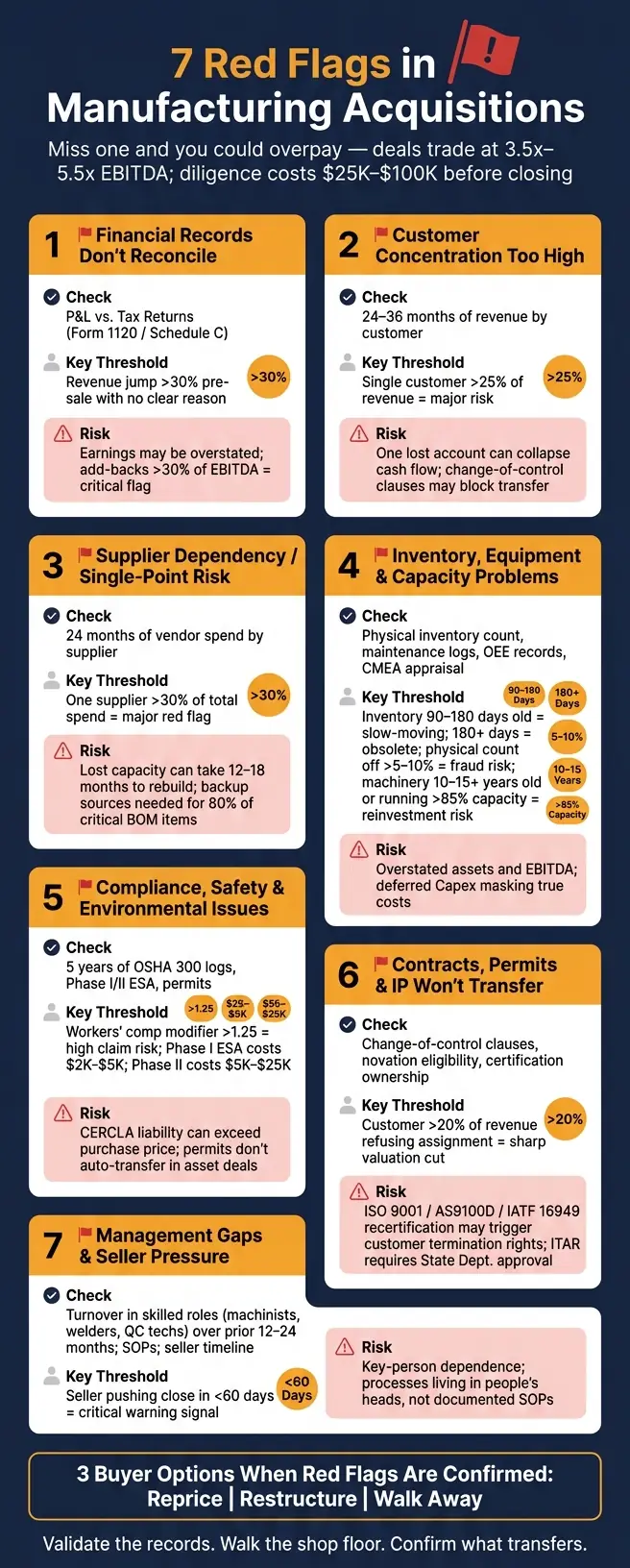
7 Red Flags in Manufacturing Acquisitions: What to Check & Why It Matters
5 Red Flags That Instantly Kill Business Value - and How to Avoid Them

Quick Comparison
| Red flag | What I’d check first | Why it matters |
|---|---|---|
| Financial mismatch | P&L vs. tax returns, A/R aging, add-backs | Earnings may be overstated |
| Customer concentration | 24–36 months of sales by customer | One lost account can hurt cash flow |
| Supplier dependency | Vendor spend by supplier, backup sources | One disruption can stop production |
| Inventory/equipment issues | Aging reports, physical counts, maintenance logs | Asset value and margins may be overstated |
| Safety/site issues | OSHA logs, permits, Phase I/II reports | Hidden cleanup or injury costs can follow the buyer |
| Transfer problems | Change-of-control clauses, lease consents, permit approvals | Revenue or plant access may not carry over |
| Seller pressure/people risk | Turnover, SOPs, delayed documents, rushed close | The business may depend too much on a few people |
My takeaway: don’t stop at the financial statements. Match the numbers to the shop floor, the customer base, the supply chain, and the paperwork that must move at closing. That’s where weak deals usually show themselves.
1. Financial Records Do Not Reconcile
Start with the seller’s P&L and federal tax return, usually Form 1120 or Schedule C. Treat the tax return as the revenue baseline, then compare the numbers line by line. If the figures still don’t line up, ask the seller to account for each gap. No shortcuts here.
In manufacturing, this check goes deeper. Inventory, WIP, and job costing should tie back to both the balance sheet and the P&L. When they don’t, margins may look better on paper than they are in practice. A couple of warning signs stand out: inventory growing faster than sales, or finished goods carried at full value even though they’re slow-moving or obsolete.
Two patterns deserve a hard look.
- A revenue jump of more than 30% in the year right before the sale, with no clear and verifiable reason, often falls back after closing.
- Higher repair and maintenance costs paired with flat capital spending can point to delayed equipment replacement, which may make short-term cash flow look better than it is.
Unknown liabilities are deal-killers unless they’re fully disclosed and covered through escrow.
For larger deals, a Quality of Earnings review can help test add-backs and normalize EBITDA. The goal is simple: rebuild earnings from source documents like bank statements, tax returns, invoices, and contracts.
| Document to Compare | Against | What to Look For |
|---|---|---|
| P&L Statements | Tax Returns (Form 1120 / Schedule C) | Discrepancies in net income or reported expenses |
| Owner Add-backs | Receipts / Payroll Records | Personal expenses or one-time costs that can’t be proven |
| Accounts Receivable Aging Report | Bank Statements | More than 15% of receivables older than 60 days; round-number manual entries |
| R&M Expense History | Capex Schedule | Rising maintenance costs with flat capital spending |
If the books reconcile, the next test is whether too much revenue depends on too few customers.
2. Customer Concentration Is Too High
Once the books tie out, the next step is simple: check whether one customer could sink the business.
If a single customer makes up more than 25% of revenue, that’s a major risk unless there’s long-term contract protection in place. Without that protection, customer concentration is a common deal-killer in manufacturing acquisitions.
Ask for 24 to 36 months of revenue by customer. That view helps you spot what’s going on beneath the top-line numbers:
- Are top accounts growing or shrinking?
- Is growth coming from actual share gains?
- Or is it just a short-term pricing bump tied to raw material inflation?
A meaningful revenue drop from a top-five customer in the last 12 months can point to concealed churn or a relationship that was already weakening before the sale process started.
The contracts matter just as much as the revenue trend. Many manufacturing supply agreements, especially with OEMs or defense contractors, include change-of-control clauses that require customer consent before ownership transfers. That changes the whole risk picture. The issue isn’t just whether a contract exists. It’s whether the customer relationship survives the transfer.
If 60% of revenue sits behind contracts with those clauses, the deal structure likely needs to be reworked before closing.
It’s also worth checking how the relationship is managed day to day. Is it documented in the CRM, or does it live only in the owner’s phone and inbox? If the seller is the sole contact for top accounts, post-close churn becomes a serious risk. Confidential calls with the top three to five customers after the LOI can help you find out whether loyalty belongs to the business or to the person who’s leaving.
If customer concentration is high, supplier concentration can create the same kind of single-point failure.
3. Supplier Dependency Creates Single-Point Risk
Supplier concentration can create the same kind of single-point failure on the input side. If one vendor controls the flow of key inputs, the business is carrying a hidden risk.
A common test applies here too: when one supplier makes up more than 30% of total spend, that’s a major red flag and often leads to valuation haircuts. The issue gets even worse with a co-manufacturer that has no qualified backup. If that partner goes down, lost capacity can take 12 to 18 months to rebuild.
Deal materials often gloss over supplier dependence, especially when the vendor is small, has no clear succession plan, or operates in a high-risk region.
Start by asking for 24 months of vendor spend. Then check whether the seller has actually qualified second sources for critical inputs. Using a deal flow management platform can help track these verification steps across multiple targets. Pay close attention to any supplier that crosses the 30% mark, and review contracts for:
- price escalation clauses
- minimum-purchase obligations
- exclusivity terms
You should also flag any change-of-control clauses or novation terms that could disrupt the relationship after an ownership change. Novation can trigger credit reviews, price resets, or tighter payment terms.
Once the contract review is done, move to backup sourcing. Confirm that the business has backup sources for at least 80% of critical BOM items. Also verify that tooling, dies, and fixtures are owned by the company, not the seller or a vendor.
4. Inventory, Equipment, or Capacity Problems Are Hidden
Inventory and equipment problems can skew value in a big way if you don’t check them closely during diligence. Obsolete stock and deferred Capex can both make EBITDA look better than it is. And when that happens, buyers can end up paying too much. This is also where sellers often bury weak production, outdated inventory, and maintenance they put off.
Start with inventory that should’ve been written down already. Stock that hasn’t moved in 90–180 days is slow-moving. Inventory older than 180 days is usually obsolete and often worth little more than scrap. If either group is still listed at full cost on the balance sheet, assets look higher than they should, and margins can look better too. Big piles of raw materials tied to a single customer project also deserve a hard look, especially when there’s no purchase order behind them.
Next, check whether the equipment can still support the margins being reported. If R&M is climbing while Capex stays flat, that’s often a sign the seller is putting off reinvestment to make cash flow look stronger. The risk gets worse when core machinery is 10–15 years old, or when the plant is running above 85% capacity with no expansion plan in place. High margins on old equipment can also hide scrap rates that aren’t being reported cleanly, or a labor team that’s simply stretched too thin. Book value can make equipment look better than it is, so an independent appraisal matters before closing.
A practical way to check this is pretty simple:
- Use a CMEA to estimate fair-market value and remaining useful life
- Reconcile a wall-to-wall inventory count to the ledger
- Review OEE, downtime, changeover times, and maintenance records
Use the checklist below to separate normal wear from value distortion.
| Warning Sign | What It Indicates |
|---|---|
| R&M costs spike while Capex stays flat | Deferred reinvestment and possible asset “milking” |
| Inventory is 90–180 days old | Slow-moving stock that may need a write-down |
| Inventory is 180+ days old | Obsolete stock, often worth little more than scrap value |
| Physical count is off by more than 5%–10% | Shrinkage, mismanagement, or potential fraud |
| Core machinery is 10–15+ years old or running above 85% capacity | Higher reinvestment risk and limited growth headroom |
Ready to Make Your Next Move?
Whether you're buying, selling, or investing — Clearly Acquired gives you the tools, data, and support to close with confidence.
5. Compliance, Safety, or Environmental Issues Are Unresolved
Compliance gaps are dangerous because they can hide liabilities that never show up in EBITDA. And some of those liabilities can get ugly fast. Environmental exposure, in particular, may have no clear cap and can even top the purchase price. Under CERCLA, buyers can inherit cleanup costs tied to past contamination, including historical contamination. That matters because post-close liabilities can wipe out reported earnings.
Start with safety. Review five years of OSHA 300 logs. A workers’ comp experience modifier above 1.25 points to higher claim risk and higher post-close insurance costs. Willful or repeat OSHA violations are another bad sign. They often point to weak controls, higher fix-it costs, and, in many cases, poor oversight, concealed incidents, or delayed disclosure.
Permits need close attention too. In an asset deal, air, water, and hazardous-waste permits do not transfer automatically. Many need agency approval, so start that process early. If you wait too long, closing can lead to operating delays.
| Category | Critical Records to Review |
|---|---|
| Safety (OSHA) | OSHA 300 logs (5 years), safety training records, machine guarding logs, incident reports |
| Environmental (EPA) | Phase I/II ESA, air/water permits, hazardous waste manifests, EPA ID numbers |
| Regulatory | Compliance calendars, warning letters, consent decrees, fire code citations |
A Phase I ESA usually costs $2,000–$5,000 and takes two to three weeks. If it flags Recognized Environmental Conditions (RECs), the next step is a Phase II with soil and groundwater sampling. That usually runs $5,000–$25,000.
To cover cleanup risk, use environmental indemnities, long survival periods, and insurance.
Once permits are checked, confirm that the contracts, licenses, and IP actually transfer with the business.
6. Key Contracts, Permits, or IP Cannot Be Transferred
A manufacturing business can look solid on paper and still fall apart in diligence if its key assets don’t move with the deal. That’s why you need to check contracts, leases, permits, certifications, and IP that may be tied to the seller or blocked by third-party consent. If the asset doesn’t transfer, the revenue tied to it may not transfer either.
The biggest trap is often a change-of-control clause. Many customer and supplier agreements let the other side terminate the deal or change pricing when ownership shifts. If major customer contracts or equipment leases need consent, the seller may lose revenue or access to key assets at closing. And if one customer makes up more than 20% of revenue and won’t consent to an assignment, that alone can sharply cut the business’s valuation. In a stock sale, a change-of-control clause can still trigger a default or a consent right.
Quality certifications need the same level of attention. An AS9100D certification can materially affect valuation, so make sure it stays in place after the ownership change. ISO 9001, AS9100, and IATF 16949 certifications may require a recertification or scope-change audit after closing, and losing them during the handoff can trigger immediate customer contract termination rights. Also check who actually holds the certification. It should be the corporate entity, not the individual owner.
Government and defense contracts make things more complicated. These usually transfer by novation, not assignment. That point needs to be checked before signing the Letter of Intent. ITAR-registered manufacturers face one more hurdle: the State Department must authorize any change in ownership, which matters even more if a foreign buyer is involved.
| Asset/Contract Type | Transfer Mechanism | Risk if Consent Is Denied or Delayed |
|---|---|---|
| Facility Lease | Landlord consent | Loss of operating site; SBA loan rejection |
| Operating Permits / Licenses | Agency approval; delay can halt closing | Illegal operations; potential shutdown |
| Quality Certifications | Recertification audit | Triggered termination of customer contracts |
| Defense Contracts | Novation | Loss of government revenue streams |
| IP/Patents | Assignment filing | Loss of competitive edge |
Match each consent, assignment, and filing against what the seller says is transferable. If something is missing, it belongs on the buyer verification checklist.
7. Management Turnover or Seller Pressure Points to Misrepresentation
After you check the books, customers, suppliers, and assets, take one more step: figure out whether the business can run without the seller.
That matters a lot in manufacturing. A plant can look fine on paper and still be fragile in practice. If daily work depends on a handful of people, and the paperwork doesn’t make that clear, you’re not just looking at a staffing issue. You may be looking at misrepresentation.
People risk is easy to miss and expensive to pay for later. High turnover in skilled roles like machinists, welders, and quality technicians during the 12–24 months before a sale is a serious warning sign. The same goes for seller pressure. If the seller is trying to close in under 60 days and leaves little time for diligence, treat that urgency as a signal in itself. Clean deals can handle scrutiny.
One of the biggest blind spots here is key-person dependence. If core operating processes live only in a few employees’ heads, instead of written Standard Operating Procedures, the business carries extreme operating risk. A simple test helps: can supervisors run day-to-day operations for several weeks without the owner?
Seller conduct during diligence can tell you almost as much as the numbers. Delayed document delivery, vague answers about customers, or pushback on a buyer-side QoE review often point to the same problem: the business looks steady only because the owner, a few employees, or the seller’s timeline is holding it together.
| Red Flag Category | Specific Indicator | Risk Level |
|---|---|---|
| Leadership | Sudden executive turnover just before or after closing | High |
| Seller Behavior | Refusal of buyer-side QoE audit or rushed timeline (<60 days) | Critical |
| Workforce | High turnover in skilled roles in the prior 12–24 months | Critical |
To pressure-test this area, ask for a 6–12 month paid transition agreement. Try to retain key non-owner employees before closing, especially lead machinists, production managers, and quality leads. Also review OSHA 300 logs for injury patterns tied to turnover.
Use the checklist below to verify whether the seller’s people risk matches the paper trail.
Seller Claims vs. Buyer Verification Checklist
Seller claims don’t mean much if the paperwork in the deal room doesn’t back them up. A lot of deals start to wobble right here: the seller says one thing, the records say another. And that gap is often where the seven red flags in this article show up.
Use this checklist to compare each claim against source documents before closing. Utilizing professional buyer tools can help organize this verification process.
| Category | Seller Claim | Buyer Check | Key Red Flag |
|---|---|---|---|
| Financials | “Our internal P&Ls accurately reflect profit.” | Reconcile 3 years of federal tax returns to the P&L. | Significant gaps between book income and taxable income. |
| EBITDA Add-Backs | “These are all one-time or personal expenses.” | Commission a CPA-led Quality of Earnings (QoE) to test each add-back. For acquisitions over $1 million, a buyer-side QoE should be standard. | Add-backs exceeding 30% of stated EBITDA. |
| Inventory | “Inventory is current and valued at cost.” | Conduct a physical count, reconcile to book inventory, and run an aging analysis. | Inventory growing faster than sales. |
| Equipment | “Machinery is in good working condition.” | Hire a Certified Machinery and Equipment Appraiser (CMEA); review all maintenance logs. | Spiking repair costs with flatlined capital expenditures. |
| Suppliers | “Our supply chain is stable and diversified.” | Map single-source dependencies and raw material price trends. | No backup source for 80% of critical BOM items. |
| Permits | “All environmental permits are current.” | Verify air, water, and waste permits directly with agencies; confirm transfer approval requirements. | Permits requiring agency approval for transfer that the seller hasn’t initiated. |
| Contracts | “Customer contracts transfer automatically at close.” | Review every contract for change-of-control clauses, novation eligibility, and explicit consent requirements. | OEM, defense, or ISO-certified contracts with no transfer language. |
A simple rule helps here: trust documents, not summaries. Internal reports can look clean while tax filings, permit records, contract terms, or maintenance logs tell a different story. That’s why buyer checks need to go past management explanations and into the source files themselves.
If a seller pushes back on basic verification, that’s not a small issue. It’s often the first sign that a risk is being glossed over rather than dealt with.
Conclusion
These red flags make one thing clear: in manufacturing deals, you have to test both the books and the plant.
A company can look strong on revenue and still fall apart under closer review. Capacity may be tight. Compliance may be weak. Key assets, know-how, or customer relationships may not transfer the way the buyer expects. On paper, the deal can look fine. On the shop floor, it can be a different story.
That’s why early diligence costs less than cleaning up a bad deal later.
Once a risk is confirmed, the buyer usually has three options: reprice, restructure, or walk away. And when several red flags show up at once, the response shouldn’t be minor. The price, deal structure, legal protections, or even the choice to move forward should change.
Validate the records. Walk the shop floor. Confirm what actually transfers. The best buyers verify first and move second.
FAQs
Which red flag should I check first?
Check owner dependency first. People often call this the Hub and Spoke trap.
If the business depends on the owner for sales, estimating, and day-to-day operations, it may be closer to a personal practice than a transferable asset.
Next, review customer concentration. If one client accounts for more than 20% to 25% of revenue, that creates major financial risk.
When should I walk away from a deal?
Walk away if due diligence turns up intentional fraud like falsified records or hidden liabilities. That’s not a small red flag. It’s a deal-breaker.
Smaller problems are different. You can often handle them with a price cut, a new deal structure, or an earnout.
You should also step back if the business has operational problems you can’t fix, major environmental liabilities, risky dependence on a single customer or supplier, or a seller who keeps refusing to share key documents.
How can I verify the seller’s claims quickly?
Prioritize checks that don’t depend on seller-provided paperwork.
- Make surprise site visits to inspect inventory and fixed assets.
- Pull raw general ledger data while the seller is present.
- Contact top customers, run lien searches in every county, and interview employees at all levels.
Why does this matter? Because these checks can surface gaps that polished documents may hide. They can expose problems with revenue, contracts, assets, vendor relationships, or labor that don’t line up with management’s claims.
About the author
Principal & CEO/CIO
Samson Jagoras has 15+ years across finance, real estate, and business acquisitions. He began his career as a Futures & Commodities broker and later served as Chief Strategy Officer of an INC 500 marketing and technology firm, helping scale revenue from $1M to over $100M. Today he buys, builds, and advises a portfolio of companies with a focus on M&A, capital allocation, and operational strategy.