Silicon Farm: How Meta's $27 Billion 'Hyperion' Project is Re-engineering Rural Louisiana
Meta's colossal Project Hyperion is transforming a former soybean farm in Richland Parish into the largest AI data center in the United States. Here's how Blue Owl Capital, Entergy Louisiana, and a coalition of construction giants are building the future of AI infrastructure.
 Samson JagorasPrincipal & CEO/CIOMarch 28, 2026
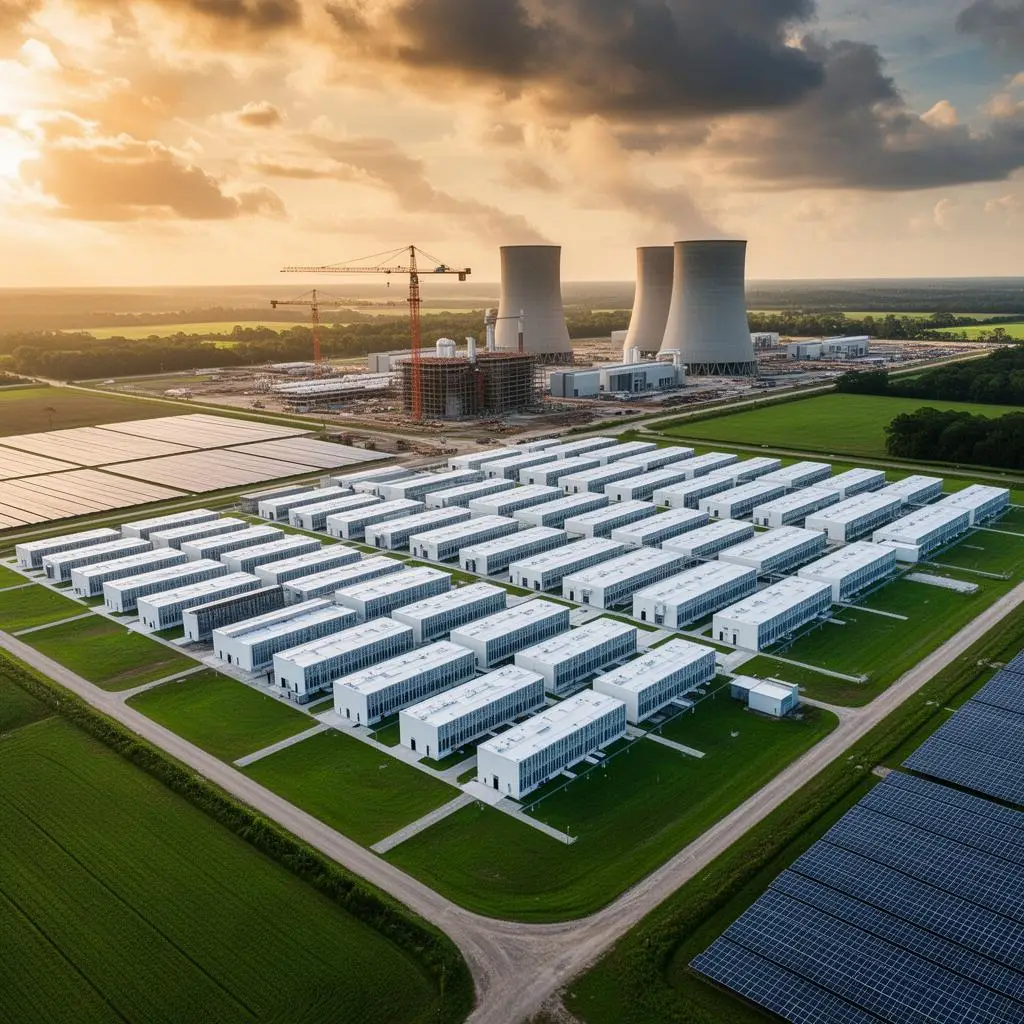
For decades, the standard blueprint for a data center investment was relatively straightforward: find a large, flat piece of cheap land near major fiber optic lines, negotiate a standard tax break, and plug into the local power grid.
But the race for Artificial Intelligence dominance has shattered the old blueprint. AI models require an order of magnitude more electricity and cooling than standard cloud services. To train its next-generation Large Language Models (LLMs), Meta didn't need a standard data center—it needed a fortress of compute.
It found its site on a former soybean farm in Richland Parish, Louisiana.
Today, we are taking a deep dive into Project Hyperion, Meta's colossal, $27 billion AI data center in northeast Louisiana. This isn't just a building; it is a paradigm shift in how hyperscalers build infrastructure, how utilities manage the grid, and how rural communities are impacted by the digital gold rush.
The "Manhattan" Scale of Hyperion
When Meta first announced its intention to build in Richland Parish in late 2024, the numbers were impressive: a $10 billion investment for a 2.2-million-square-foot campus.
By early 2026, those numbers were viewed as mere phase-one projections.
The revised "Hyperion" roadmap is staggering:
- A Multi-Campus Site: The facility now spans 2,250 acres—a site so large that Mark Zuckerberg famously noted it could cover a significant portion of Manhattan.
- Total Investment: The original $10 billion figure has ballooned. When including the associated private energy generation, the total investment is now estimated closer to $27 billion.
- Compute Capacity: It is designed to deliver 2 to 5 gigawatts (GW) of dedicated compute power at full build-out. To put that in perspective, 5 GW is enough electricity to power roughly 3.7 million homes.
- Purpose: This facility is the "crown jewel" of Meta's global fleet, built exclusively to train the most advanced versions of Llama, Meta's open-source LLM.
The Deep Pocket Players: Capital & Construction
A project of this scale cannot be built by one company alone. It required the formation of a massive ecosystem of financial and construction giants. If you are following the money in the AI boom, these are the names you need to know.
1. The Financial Backbone: Blue Owl Capital
Perhaps the most critical, yet less-publicized, component of the deal is how it is being financed. In October 2025, Meta entered into a $27 billion infrastructure partnership with Blue Owl Capital.
Under this novel agreement, Blue Owl—a giant in alternative asset management—will hold the majority stake in the data center infrastructure assets, while Meta retains roughly 20% equity and a long-term lease agreement. This structure allows Meta to keep billions in capital expenditure off its balance sheet while guaranteeing its access to the massive compute capacity it needs.
2. The Power Broker: Entergy Louisiana
To solve the AI energy puzzle, Meta had to essentially become its own utility. It partnered with Entergy Louisiana, led by CEO Phillip May.
Entergy worked with state regulators to create a "pay-for-your-own-power" model. Under this agreement, Meta is directly funding the construction of a private energy network through Entergy. In exchange, the regulatory deal is structured to save other Entergy customers nearly $2 billion over the next 20 years by allowing Entergy to share in the infrastructure efficiencies.
3. The Construction "Dream Team" (Joint Venture)
You don't hire one contractor to build a city. You hire a coalition. The Hyperion campus is being managed by a joint venture of three of the largest construction management firms in the world:
- DPR Construction
- Turner Construction
- Mortenson
At peak construction (forecasted through 2028), this JV will manage over 5,000 workers on-site, making it one of the largest active construction projects in the United States.
Ready to Make Your Next Move?
Whether you're buying, selling, or investing — Clearly Acquired gives you the tools, data, and support to close with confidence.
Solved: The AI Energy Riddle
The most revolutionary aspect of Hyperion is how it addresses its massive power footprint without collapsing the local grid.
The Natural Gas Bridge
To get online fast and provide the unwavering stability required for training LLMs, the JV is constructing ten dedicated, new natural gas-fired power plants on-site. The initial phase will use Entergy-built combined-cycle plants designed with potential future carbon-capture capability. This reliance on natural gas has drawn criticism from environmental groups, highlighting the tension between rapid AI deployment and climate goals.
The Renewable & Nuclear Commitment
Meta has stressed that its dependency on fossil fuels is a "bridge." The company has committed to adding 2,500 megawatts (2.5 GW) of new renewable energy (predominantly solar) to the Louisiana grid by 2030 to "match" its consumption. Furthermore, the JV signed a memorandum of understanding with Entergy to explore advanced nuclear solutions, including small modular reactors (SMRs), as a long-term, carbon-free baseload option.
The Rural Impact: Boomtown and Anxiety
For Richland Parish, a largely agrarian community of fewer than 20,000 people, the arrival of Meta is a cataclysmic economic event.
The Upside
The project is creating over 500 high-paying permanent operational jobs (average salaries exceeding 150% of the state average). More importantly, Meta is making a concerted effort to "source locally" and has committed an extra $200 million for parish infrastructure upgrades, funding new roads, water, and wastewater systems that the local tax base simply couldn't previously afford.
The Friction
The transition hasn't been seamless. Some residents in Holly Ridge have expressed frustration over the sudden "industrialization" of their quiet community. The massive influx of 5,000 construction workers has led to housing shortages, unprecedented traffic congestion on two-lane country roads, and a rise in noise pollution. What was once farm fields is now a massive, 24/7 industrial zone.
The Takeaway
The Meta Hyperion project in Louisiana is a masterclass in modern infrastructure.
It is no longer just about buying servers; it is about building the entire vertical supply chain—from financing structure (Blue Owl) to power generation (natural gas and solar) to local infrastructure negotiation.
As Hyperion slowly goes "lights on" over the next five years, it will stand as a model for how the tech industry's computational ambitions will remodel the landscapes of rural America.
About the author
Principal & CEO/CIO
Samson Jagoras has 15+ years across finance, real estate, and business acquisitions. He began his career as a Futures & Commodities broker and later served as Chief Strategy Officer of an INC 500 marketing and technology firm, helping scale revenue from $1M to over $100M. Today he buys, builds, and advises a portfolio of companies with a focus on M&A, capital allocation, and operational strategy.