How to Manage Brand Transition During Business Acquisition
Protect brand equity and revenue during acquisitions with audits, phased roadmaps, clear communications, and SEO-safe migrations.
 Samson JagorasPrincipal & CEO/CIOJune 10, 2026

When businesses merge or one acquires another, managing brand transition is often as critical as the financial deal itself. A poorly executed transition can lead to customer loss, employee uncertainty, and diminished value. Here's what you need to know:
- Brand Transition Definition: Aligns or merges two company identities into one market presence, unlike a simple rebrand.
- Brand Equity: Protecting the acquired brand's trust, loyalty, and market value is key. Mishandling this can destroy goodwill.
Key Steps:
- Audit Both Brands: Evaluate logos, customer perceptions, and search rankings.
- Set Clear Goals: Focus on revenue protection, employee retention, and digital presence.
- Choose a Transition Model: Options include merging brands, keeping them separate, or gradual integration.
- Develop Guidelines: Ensure consistency in messaging, visuals, and customer communication.
- Measure Success: Track metrics like customer retention, search traffic, and employee engagement.
The process requires careful planning, data-driven decisions, and clear communication to employees and customers. Professional acquisition consultation services can help navigate these complexities. Starting early and staying consistent ensures a smoother transition and preserves the value of both brands.
What Happens to a Brand After an Acquisition?

Assessing the Current Brand Landscape
Before making any announcements or changes, it's essential to evaluate both your brand and the one you're acquiring.
Conducting a Brand Audit
A brand audit is your chance to take a deep dive into everything that defines a brand's identity and presence in the market. This includes elements like logos, color palettes, taglines, domain authority, organic search traffic, and backlink profiles. It also involves cataloging sub-brands, product lines, and regional naming variations, then analyzing their revenue and profit contributions.
One often-overlooked area is how AI-driven systems portray your brand. Tools like ChatGPT and Gemini actively shape public perception. Running structured AI-based brand queries can help uncover outdated or inconsistent information that might confuse stakeholders after the acquisition.
"The most expensive mistake I consistently see founders and acquirers make is commissioning the brand integration work after the deal terms are agreed. By that point, the leverage has gone." — Stuart Crawford, Founder, Inkbot Design
Brand assets can account for 20% to 40% of a consumer-facing business's total enterprise value. Treating the audit as an afterthought risks losing significant value. By conducting the audit alongside financial due diligence and a business acquisition checklist, you ensure that branding is a core part of the deal process — not an afterthought.
These insights are critical for understanding and quantifying the market value of both brands.
Evaluating Brand Equity Metrics
To assess brand equity, use a measurable framework that includes at least five key metrics: Net Promoter Score (NPS), customer churn rate, organic search traffic, domain authority, and referral rates. These numbers will guide your communication and integration strategies during the transition.
"Brand equity is not how much the team loves their logo. It's the measurable value a brand name carries in the market." — Alyssa Pfennig, CEO, Hekate Strategies
Take the T-Mobile and Sprint merger in April 2020 as an example. Deutsche Telekom decided to retire the Sprint brand because T-Mobile had stronger NPS scores and greater appeal among younger customers. Within two years, T-Mobile's subscriber growth outpaced what the two brands had achieved separately before the merger. This decision was based on data, not sentiment.
It's also crucial to establish baseline metrics before making any public announcements. Tracking brand awareness and recognition from the outset provides a benchmark to measure progress over the 18–24 months typically needed to fully realize the impact of a brand transition.
Setting Transition Objectives
With audit findings and brand equity metrics in hand, you can set transition objectives that align with your strategic goals. For instance, if the acquisition is about entering a new market, the brand transition should support that entry. For those looking to buy a business and expand their portfolio, these strategic alignments are vital. If it's about streamlining operations, the goal might focus on presenting a unified brand that conveys efficiency and stability.
Every brand transition plan should prioritize three main objectives. First, protect revenue by minimizing customer churn, which often ranges from 2% to 5% during mergers. Second, retain talent by sharing a clear and compelling narrative about the new brand identity with employees — ideally 48 to 72 hours before any public announcement. Third, maintain digital authority by safeguarding SEO equity during domain or platform changes.
"The decision about which brand survives... gets made by the wrong criteria. Whoever has more seats at the table wins... None of that is brand equity. And all of it costs you." — Alyssa Pfennig, CEO, Hekate Strategies
Developing a Brand Transition Strategy
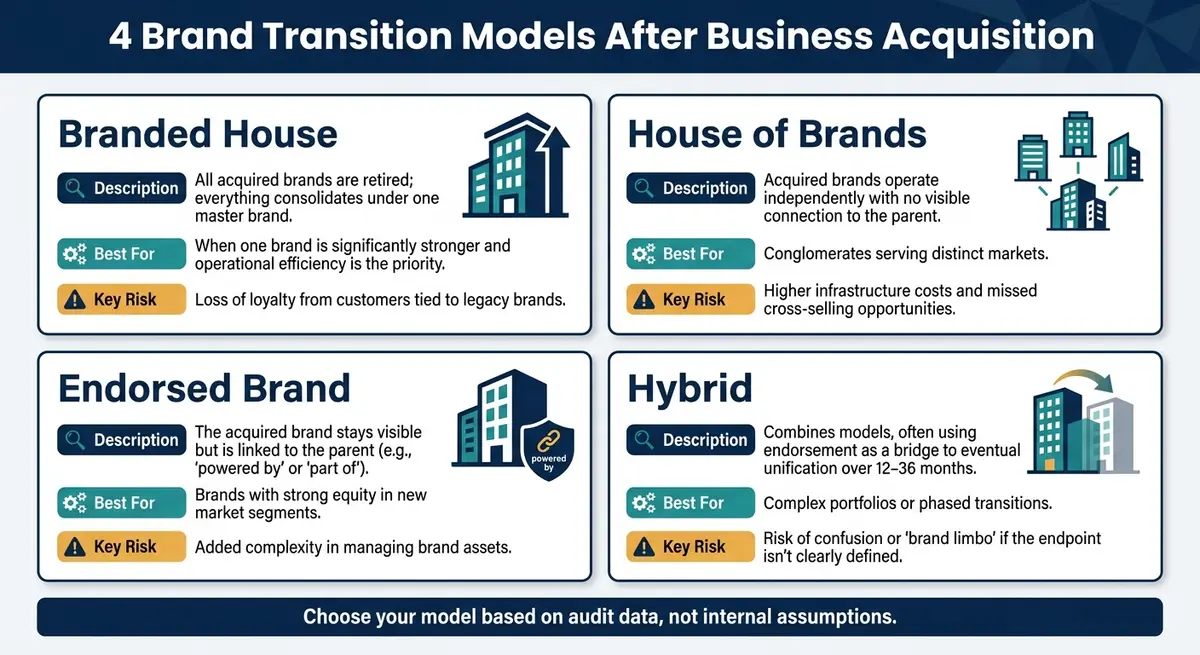
To successfully merge brand identities, it's essential to pick the right structure, create a detailed roadmap, and establish clear guidelines. This process builds on the insights gained from your brand audit and ensures a smooth transition.
Choosing a Brand Transition Model
The choice of transition model should be based on data from your audit, not internal biases or assumptions. The right model helps safeguard revenue, retain key talent, and maintain digital authority. As Stuart Crawford, Brand Strategist at Inkbot Design, aptly puts it:
"The assumption that the acquiring company's identity simply absorbs the target is not a strategy; it is laziness dressed up as efficiency."
Here are four main models to consider, each with its own strengths and risks:
| Model | Description | Best For | Key Risk |
|---|---|---|---|
| Branded House | All acquired brands are retired, consolidating everything under one master brand. | Ideal when one brand is much stronger and operational efficiency is a priority. | Loss of loyalty from customers tied to the legacy brands. |
| House of Brands | Acquired brands operate independently with no visible connection. | Works well for conglomerates serving distinct markets. | Higher infrastructure costs and missed opportunities for cross-selling. |
| Endorsed Brand | The acquired brand stays visible but is linked to the parent (e.g., "powered by" or "part of"). | Suited for brands with strong equity in new market segments. | Adds complexity to managing assets. |
| Hybrid | Combines models, often using endorsement as a bridge to eventual unification. | Useful for complex portfolios or phased transitions over 12–36 months. | Risk of confusion or "brand limbo" if the endpoint isn't clearly defined. |
A great example of the House of Brands model is Meta's 2012 acquisition of Instagram. Instead of absorbing Instagram into Facebook, Meta kept it separate. By 2025, Instagram's user base rivaled that of the parent brand — proving that the acquiring company doesn't always need to take center stage.
Creating a Brand Transition Roadmap
A phased approach works best, and a 100-day plan is a good starting point. This plan can be broken into three key phases:
- Days 1–30: Establish guardrails and set initial guidelines.
- Days 31–60: Develop frameworks for the transition.
- Days 61–100: Rationalize the portfolio and finalize details.
FedEx provides a strong example of a phased transition. When it acquired Kinko's, the name evolved gradually — from "Kinko's" to "FedEx Kinko's", and finally to "FedEx Office." This allowed customers to adjust to the change over time. A similar phased approach, spanning 12–36 months, can help reduce customer attrition.
Your roadmap should also include critical technical and legal steps like:
- Setting up 301 redirects and transferring backlinks.
- Consolidating Google Business Profiles.
- Clearing legal trademarks.
- Integrating systems that impact customer-facing touchpoints.
These steps lay the groundwork for a smooth transition and ensure your communication strategy aligns with the new brand identity.
Developing Brand Guidelines
Once your audit is complete and metrics are defined, it's time to update your brand guidelines. These guidelines ensure all communications consistently reflect the new brand identity.
Good guidelines go beyond logo placement. They should define:
- The mission and values of the combined entity.
- Naming conventions for sub-brands.
- A tone of voice tailored to different audiences.
- Templates for email signatures, pitch decks, and sales materials.
In today's digital age, guidelines also need to address content optimization for AI systems like ChatGPT and Gemini. This ensures AI tools correctly index the new brand and don't surface outdated information about legacy brands.
To make these guidelines effective, identify "brand champions" across key departments like sales, HR, and operations. These individuals can model the new standards and help address questions from their teams. Remember, guidelines are only useful if they're actively adopted — and that requires visible leadership, not just a PDF sitting on a shared drive.
Ready to Make Your Next Move?
Whether you're buying, selling, or investing — Clearly Acquired gives you the tools, data, and support to close with confidence.
Executing Brand Transition and Communication
With your brand guidelines and roadmap in place, the next step is putting everything into action. This is where strategies are tested, and outcomes are determined. The key to success lies in proper sequencing: ensure your internal operations are aligned before making any public-facing announcements.
Internal Communication and Training
Your employees will experience the new brand before anyone else, and their ability to articulate it effectively is crucial. Leadership plays a pivotal role here. Actions and consistent messaging from leaders are far more impactful than any brand manual or memo. For example, Fabrik Brands highlighted in 2026 how a merger CEO set the tone by repeatedly stating in meetings, "We're not the old brands anymore; we're building this together." This kind of deliberate messaging helps unify senior staff before the broader organization is brought on board.
A structured 12-week plan can be effective: align leadership first, roll out clear messaging across teams, and empower specific individuals to act as change advocates.
For customer-facing teams, provide practical tools like one-page playbooks, FAQs, and clear talking points. These resources should focus on helping employees explain the changes confidently and calmly. The goal isn't to memorize scripts but to instill confidence. When a sales representative can clearly articulate the transition and its benefits, it reassures clients and fosters trust. This internal preparation sets the stage for a smooth external rollout.
External Communication Strategy
When it comes to external communication, timing and tone are everything. Don't wait for perfection — leaving an information gap can lead to speculation and uncertainty. If customers, suppliers, or investors don't hear from you, they might create their own (often incorrect) narratives.
Approach communication in stages: start with investors and key partners, then move to customers, and finally address the broader market. Keep the focus on the value for customers — what the transition means for them — rather than delving into internal strategic or financial motives.
If your final brand identity isn't ready at the time of the announcement, use a holding message to acknowledge the change and outline what's ahead. A simple and honest statement like, "We're in transition, and here's what you can expect", can go a long way in preserving trust during uncertain times.
Updating Digital and Physical Assets
Once your external messaging is set, it's time to update all customer-facing assets to reflect the new brand identity. Start with high-visibility touchpoints like your website, email signatures, and social media profiles. If a full website overhaul isn't ready for launch, consider a temporary holding page or quick updates to the existing site to reflect the new direction.
Pay special attention to maintaining SEO authority. For instance, in April 2026, Hekate Strategies worked with 360 Fire & Flood to unify several companies under a single digital presence. This included a carefully sequenced rollout of 301 redirects and the consolidation of Google Business Profiles to protect their organic search rankings. Skipping these steps can harm your online visibility.
Physical assets, such as signage, invoices, packaging, and vehicle wraps, often take more time and money to update. Prioritize updates based on customer visibility. For example, update a client-facing office lobby before addressing less visible areas like a warehouse interior. In the meantime, use transitional branding — such as "formerly [Legacy Brand]" or "now part of [Parent Company]" — on materials that can't be replaced right away. This approach helps bridge the gap for customers, maintaining continuity and trust until the transition is fully validated through performance reviews.
Measuring Success and Ensuring Alignment
Defining Success Metrics
After launching your new brand identity, it's crucial to measure its impact effectively. Start by recording key metrics before the transition to create a solid baseline. This way, you'll have real data to track progress, rather than relying on guesses. These metrics should align with your transition roadmap, offering insights to guide ongoing adjustments.
Focus on key areas like brand strength (awareness, search volume, share of voice), customer health (retention, NPS, churn), sales performance (lead volume, pipeline velocity, win rates), and internal health (employee retention, engagement scores). Track these at intervals like 30 days, 90 days, and 6–12 months. For example, at 30 days, prioritize employee sentiment and initial brand awareness. At 90 days, shift focus to retention and lead generation. By the 6–12 month mark, assess how your market position has evolved.
Coordinating Cross-Functional Teams
Once your success metrics are set, the next step is ensuring all teams work together toward shared goals. A lack of coordination across departments can lead to a fragmented customer experience, undermining the entire transition. Marketing, IT, HR, sales, and legal each play a role in shaping the brand experience, so alignment is essential.
This is where a dedicated Integration Management Office (IMO) can make a difference. Acting as a central hub, the IMO ensures all departments stay aligned and progress remains steady. McKinsey emphasizes the importance of marketing in this process:
"Marketing plays a vital role in integration and deal success and should not be an afterthought. Rather, marketing should lead the organization in developing fresh, compelling value propositions and setting the new organization's brand strategy."
In practice, the Chief Marketing Officer (CMO) collaborates with IT on system transitions, works with HR on aligning company culture, and partners with sales to refine cross-selling strategies. Decisions about brand architecture should prioritize clarity over consensus. As Steve Harvey, Co-founder of Fabrik Brands, explains:
"Brand architecture after a merger isn't about democracy. It's about clarity. The fastest way to stall integration is to let everyone negotiate naming and structure by committee."
Refining the Transition Post-Launch
Measuring success doesn't stop after the launch. Post-launch feedback is critical for fine-tuning the transition. Even the most detailed planning can't account for every challenge that arises once the new brand identity is live. The focus during this phase isn't on achieving perfection — it's about learning quickly and making adjustments.
Pay close attention to initial customer interactions, like the first customer service calls, sales pitches, or invoices featuring the new branding. These moments can reveal potential friction points that need immediate attention. Tools like social listening, analysis of support ticket trends, and direct feedback from sales teams can help you spot recurring issues. Use this information to tweak your messaging or adjust timelines as needed, ensuring the transition stays on track.
Conclusion: Managing Brand Transition with Confidence
Brand transition isn't a one-and-done event — it's a process that unfolds over time, requiring careful planning and execution.
"The most consequential branding decision you can make after an acquisition isn't what to name the new entity or which logo survives... It's when you start." — Douglas Spencer, CEO, Spencer Brenneman
To navigate this process effectively, focus on the essentials: thorough audits, clear roadmaps, internal alignment, and consistent metrics. These steps set the groundwork for smooth execution and long-term success.
Strategic planning should take priority over superficial updates. Using early, data-driven evaluations helps protect the brand equity you've built. Before diving into visual elements like logos or names, ensure you've clarified your core purpose and customer promise. Skipping this step can lead to expensive missteps later.
Once the foundation is in place, the next phase is all about execution and continuous improvement. Transition doesn't stop at launch — it involves ongoing monitoring, adapting to customer feedback, refining your messaging, and ensuring your digital tools and systems align with the new identity. Platforms like Clearly Acquired can simplify this process, guiding you through a post-acquisition workflow and helping ensure your efforts deliver the intended outcomes. Brand transition is highly visible, but with the right preparation, it's a challenge you can tackle confidently.
FAQs
When should we start brand transition planning?
Start planning your brand transition as early as you can — ideally during the acquisition structuring phase. Why? Because branding isn't just a post-deal afterthought; it's a critical piece of the puzzle. When you prioritize brand strategy early on, you can protect your brand equity, ensure leadership alignment, and avoid the uncertainty or competitive risks that often surface after the announcement. Early planning sets the stage for a smoother transition and fewer surprises down the line.
Which brand transition model fits our acquisition?
The best approach for transitioning a brand depends on what you aim to achieve, how strong the brands are, and how much overlap exists between customer bases. Here are some common strategies:
- Absorption: This involves retiring the acquired brand and moving its customers under the acquiring brand.
- Endorsement: The acquired brand continues to operate, but with a clear endorsement from the parent company.
- House of Brands: Both brands remain separate and operate independently.
- Merger: Both brands are retired, and a completely new brand is created.
Choose the model that aligns with your long-term goals to ensure the brand's value is preserved.
How do we protect SEO during a rebrand?
To safeguard your SEO during a brand transition, start with a comprehensive migration plan that focuses on preserving your digital authority. Use 301 redirects for all old URLs to retain your backlink profile and sustain organic traffic. Update citations across online directories, streamline your Google Business Profile, and thoroughly audit tracking systems, paid campaigns, and conversion tools. This helps prevent broken links, data gaps, or any performance interruptions during the transition.
About the author
Principal & CEO/CIO
Samson Jagoras has 15+ years across finance, real estate, and business acquisitions. He began his career as a Futures & Commodities broker and later served as Chief Strategy Officer of an INC 500 marketing and technology firm, helping scale revenue from $1M to over $100M. Today he buys, builds, and advises a portfolio of companies with a focus on M&A, capital allocation, and operational strategy.