Installment Sales Tax Guide for Business Sellers
Installment sales let you spread taxable gain over years—but depreciation recapture, AFR rules, and Form 6252 reporting can trip up sellers. Here's how to structure your deal.
 Samson JagorasPrincipal & CEO/CIOMay 31, 2026

Sell your business for maximum value
Our sell-side advisors package, market, and negotiate your exit to qualified, verified buyers — confidentially.
When selling a business, installment sales can help you spread out tax payments over time, reducing your immediate tax burden. Here's what you need to know:
- What is an installment sale? You sell an asset and receive at least one payment in a later tax year. The IRS automatically applies installment sale rules unless you opt out.
- Tax advantage: Instead of paying taxes on the entire gain in one year, you pay proportionally as payments are received. This can keep you in lower tax brackets.
- Payment breakdown: Each payment includes a tax-free return of your basis (your original investment), capital gain taxed at long-term rates (up to 23.8%), and interest income taxed as ordinary income (up to 40.8%).
- Key risks: Depreciation recapture is taxed immediately at ordinary income rates. Certain actions, like pledging the note as collateral, can trigger early tax recognition.
- Forms to file: Use Form 6252 annually to report payments and calculate taxable amounts.
Proper exit strategy planning is essential to avoid surprises. Work with advisors early to structure your deal, follow a proven business selling system, cover immediate tax liabilities, and maximize after-tax proceeds.
Ten Minutes with Griffin, Episode 146: IRS Form 6252: Reporting Installment Sale Income

How to Calculate Taxable Gain on Installment Sales
Getting a handle on the math behind installment sales can make a big difference when it comes to planning for taxes. The process is straightforward once you know the three main numbers involved.
Key Terms: Selling Price, Adjusted Basis, and Contract Price
To calculate your taxable gain, you'll need these three figures:
- Selling Price: This is the total price agreed upon for the business, including any portion financed by the seller.
- Adjusted Basis: The original cost of the assets, reduced by any depreciation claimed over time.
- Contract Price: Usually matches the selling price. However, if the buyer assumes qualifying debt, subtract that debt from the selling price to get the contract price.
Your gross profit is determined by subtracting the adjusted basis, selling expenses (like legal fees or M&A advisory costs), and depreciation recapture from the selling price. The formula looks like this:
Gross Profit = Selling Price − (Adjusted Basis + Selling Expenses + Depreciation Recapture)
One important note: Depreciation recapture under IRC §1245 and §1250 isn't eligible for installment treatment. It's treated as ordinary income and taxed in Year 1, regardless of when the payments are actually received.
Gross Profit Percentage and How It Affects Tax Reporting
Once you've got the numbers, you'll use the Gross Profit Ratio (GPR) to figure out how much of each payment is taxable. The formula is:
GPR = Gross Profit ÷ Contract Price
This percentage determines the taxable portion of every principal payment. Let's break it down with an example of a $5,000,000 business sale:
| Item | Value |
|---|---|
| Selling Price | $5,000,000 |
| Adjusted Basis | $1,000,000 |
| Selling Expenses | $200,000 |
| Depreciation Recapture | $500,000 |
| Gross Profit | $3,300,000 |
| Contract Price | $5,000,000 |
| Gross Profit Ratio (GPR) | 66% |
Here's what this means: for every dollar of principal received, $0.66 is taxable capital gain, and $0.34 is tax-free return of basis. This ratio remains constant throughout the payment period.
"The gross profit ratio determines the gain percentage of each payment." - Christoph Totter, Managing Partner, CT Acquisitions
Selling expenses, like advisor fees, directly reduce your gross profit (the numerator) without affecting the contract price (the denominator). This makes them fully deductible against your gain, which can be a major advantage if handled correctly from the start.
How Each Payment Is Split: Principal, Interest, and Gain
Once you know the GPR, you can break down every payment into its taxable components:
| Payment Component | Tax Treatment | Federal Rate (Max) |
|---|---|---|
| Return of Basis | Tax-free | 0% |
| Capital Gain | Long-Term Capital Gain | 23.8% (incl. NIIT) |
| Interest Income | Ordinary Income | Up to 40.8% (incl. NIIT) |
The interest portion is taxed separately from the principal and is based on the stated interest rate on your seller note. Interest is taxed as ordinary income, so it's important to ensure your rate meets or exceeds the Applicable Federal Rate (AFR). For example, as of March 2026, the mid-term AFR for notes lasting 3–9 years was 5.12%. If your rate falls below this, the IRS might reclassify part of your principal as interest, which could push more of your income into higher tax brackets.
The principal portion is divided according to the GPR. Using the earlier example, a $100,000 principal payment would include $66,000 of taxable capital gain (taxed at 23.8% federally for most sellers) and $34,000 returned tax-free as basis. This setup spreads out the tax burden over time, providing a clear deferral advantage.
Annual Reporting and IRS Compliance for Installment Sales
Once your sale is complete and payments start rolling in, the clock begins ticking on annual tax filings. The IRS requires specific forms and documentation every year until the note is fully paid. Getting this process right from the beginning can save you from costly errors down the road.
Form 6252: How to Report Installment Sale Income
Form 6252 is the go-to document for reporting installment sales. It's mandatory to file it in the year you close the sale, even if you don't receive any payments that year, as this establishes your Gross Profit Ratio (GPR). Afterward, you'll need to file it annually for every year a payment is received.
Form 6252 helps calculate key figures like gross profit, contract price, GPR, and the taxable gain for the year. The results from this form then flow into other IRS forms, depending on the type of income being reported:
| Payment Component | Reporting Location |
|---|---|
| Return of Basis | Form 6252 |
| Capital Gain | Form 6252 → Schedule D or Form 4797 |
| Interest Income | Schedule B |
| Depreciation Recapture | Form 4797 (Year 1 only) |
A couple of important notes: Interest income is reported separately on Schedule B, while depreciation recapture - fully taxable in the first year - is reported on Form 4797. These filings also prepare you for handling imputed interest rules, which come into play next.
Interest Income and IRS Imputed Interest Rules
The interest rate on your seller note has a direct impact on your tax liability. The IRS mandates that the rate meets or exceeds the Applicable Federal Rate (AFR) for the month in which the sale closes. For example, as of March 2026, the mid-term AFR (covering notes with 3–9 year terms) was 5.12%.
If your stated interest rate is lower than the AFR, the IRS may reclassify part of your principal payments as interest under §1274 and §483. This process, known as imputed interest, shifts income from long-term capital gains rates (up to 23.8%) to ordinary income rates (up to 40.8%). That's a tax hit you'll want to avoid.
"The tax-optimal approach is to charge EXACTLY the AFR - high enough to avoid imputed-interest issues, but no higher than necessary. This minimizes ordinary-income tax and maximizes the LTCG-eligible portion of each payment." - Christoph Totter, Managing Partner, CT Acquisitions
By setting your interest rate at the AFR, you keep interest income at the minimum required level while preserving as much of your payments as possible for the lower capital gains rate. This strategy ensures your tax filings reflect the intended benefits of your installment sale.
Recordkeeping and Documentation Requirements
Proper documentation is essential for accurate filings and staying on the IRS's good side. Good recordkeeping not only helps during audits but also ensures you're filing correctly each year. Sellers should hold onto these documents for the full term of the note:
| Document | Purpose |
|---|---|
| Promissory Note | Outlines principal, interest rate, payment schedule, and maturity |
| Amortization Schedule | Breaks down interest and principal for annual reporting accuracy |
| Form 8594 (Asset Allocation) | Differentiates depreciation recapture from deferred gains |
| Security Agreement / UCC-1 Filing | Details collateral and legal claims on assets |
| Payment Log | Tracks payment amounts and dates for Form 6252 filings |
A detailed payment log is particularly important. Each entry should break down payments into their three components: return of basis, capital gain, and interest income. These records, aligned with Form 6252 calculations, create a solid audit trail that can protect you if the IRS ever questions your filings.
Advanced Tax Considerations for Installment Sales in Business Exits
Depreciation Recapture and How It Is Taxed
Depreciation recapture is one of those tax elements you can't defer - it's taxed in full during the year of the sale, no matter how the deal is structured. Under IRC §1245 and §1250, the IRS requires the entire recapture amount to be reported as income right away, even if you haven't received the full cash payment.
For §1245 property - like equipment, vehicles, and machinery - the tax rate aligns with ordinary income rates, which can go up to 37%. When you add the 3.8% Net Investment Income Tax (NIIT), the effective rate climbs to 40.8%. On the other hand, §1250 property, which includes real estate, is taxed at a maximum of 25% for unrecaptured gains.
Here's an example to put this into perspective: In a $5,000,000 sale with $500,000 subject to depreciation recapture, a seller at the 37% ordinary income rate would owe $185,000 in federal taxes in year one. And this is true even if the seller only received a small down payment at closing. This is why structuring the cash-at-close portion of the deal to cover immediate tax liabilities is so critical.
Events That Trigger Early Gain Recognition
Certain actions after the deal closes can force you to recognize deferred gains earlier than planned. Here are some common triggers:
| Trigger Event | Tax Impact | Legal Reference |
|---|---|---|
| Pledging the note as collateral | Immediate gain recognition on amount borrowed | IRC §453A(d) |
| Selling or disposing of the note | Recognition of remaining deferred gain | IRC §453B |
| Gifting the note | Treated as a taxable disposition | IRC §453B |
| Note cancellation | Remaining gain becomes taxable | IRC §453B |
| Buyer prepayment | Full remaining gain recognized in year of payment | IRC §453 |
One of the most common pitfalls is pledging the installment note as collateral. For example, if you use the note to secure a personal loan - say, for buying a house - the IRS treats the loan amount as a constructive payment under §453A(d). This means you'll have to recognize the gain immediately. If you need liquidity, it's generally safer to explore unsecured personal credit options.
For larger deals, where outstanding installment receivables exceed $5,000,000, the IRS adds another layer: an additional interest charge on the deferred tax liability under §453A. This effectively treats the deferred tax as a loan from the government.
How Deal Structure and Asset Allocation Affect Tax Outcomes
The way the purchase price is allocated across asset classes can make or break your overall tax strategy. This allocation, governed by IRC §1060, is a key factor in maximizing the tax benefits of installment sales.
- Buyers prefer allocations toward depreciable assets because they can write them off faster.
- Sellers, on the other hand, benefit from allocations toward goodwill, which qualifies for long-term capital gains rates (23.8%) and is fully eligible for installment deferral.
However, assets like inventory and accounts receivable are taxed as ordinary income and are typically recognized in the year of sale.
"A poorly-structured $5M sale can net the same as a well-structured $4M sale. Owners who understand the tax math before they sign an LOI consistently end up with $300K–$1M+ more in their pocket." - Christoph Totter, Managing Partner, CT Acquisitions
If you're locked into an asset sale, negotiating a price gross-up can help offset the higher tax burden from depreciation recapture. Alternatively, pushing for a stock sale can eliminate recapture entirely, allowing the entire gain to be treated as a capital gain. Timing is everything here - work out the allocation details before signing the letter of intent, not during due diligence.
One last thing to keep in mind: state tax rules can override federal treatment. For example, California doesn't follow federal installment sale rules and may require full gain recognition in the year of sale, regardless of when payments are received. If you're in a high-tax state, it's essential to account for this in your planning well ahead of the sale.
Get a Quality of Earnings analysis you can trust
Connecting Installment Sales to Exit Planning and Financing
Using Seller Financing to Manage Tax and Cash Flow
When structuring a seller note, the terms you choose - such as the down payment, interest rate, and note duration - can have a big impact on your taxes and cash flow after the sale. These elements are key levers in managing your financial outcomes.
Let's start with the down payment size. This is the first and most immediate factor to address. It's important to ensure that your down payment is enough to cover any immediate depreciation recapture liability, as previously discussed. Before finalizing your agreement, model your tax exposure for the first year to avoid surprises.
The interest rate on the note is another critical piece. Interest income gets taxed at ordinary income rates, which can reach as high as 40.8% federally. In contrast, the principal payments are taxed at the long-term capital gains rate of 23.8%. To keep your ordinary income exposure low, aim to set the interest rate at or slightly above the Applicable Federal Rate (AFR).
Finally, the note length determines how long your gains are spread out, which can influence your annual tax bracket. For example, the typical seller note in deals under $5 million has a 6.2% interest rate and a five-year term. The best structure for you will depend on your overall income and financial goals.
If the buyer is using an SBA 7(a) loan vs. other financing options, keep in mind that your seller note will likely need to stay on "full standby" for 12 to 24 months, meaning you won't receive payments during that time. This delay should be factored into your cash flow planning.
"Seller financing isn't charity - it's a strategic tool that benefits both parties. Buyers get flexible terms and sellers get tax benefits, higher prices, and recurring income." - Mark Sanborn, Certified Business Intermediary
Installment Sales vs. Other Exit Structures: A Side-by-Side Look
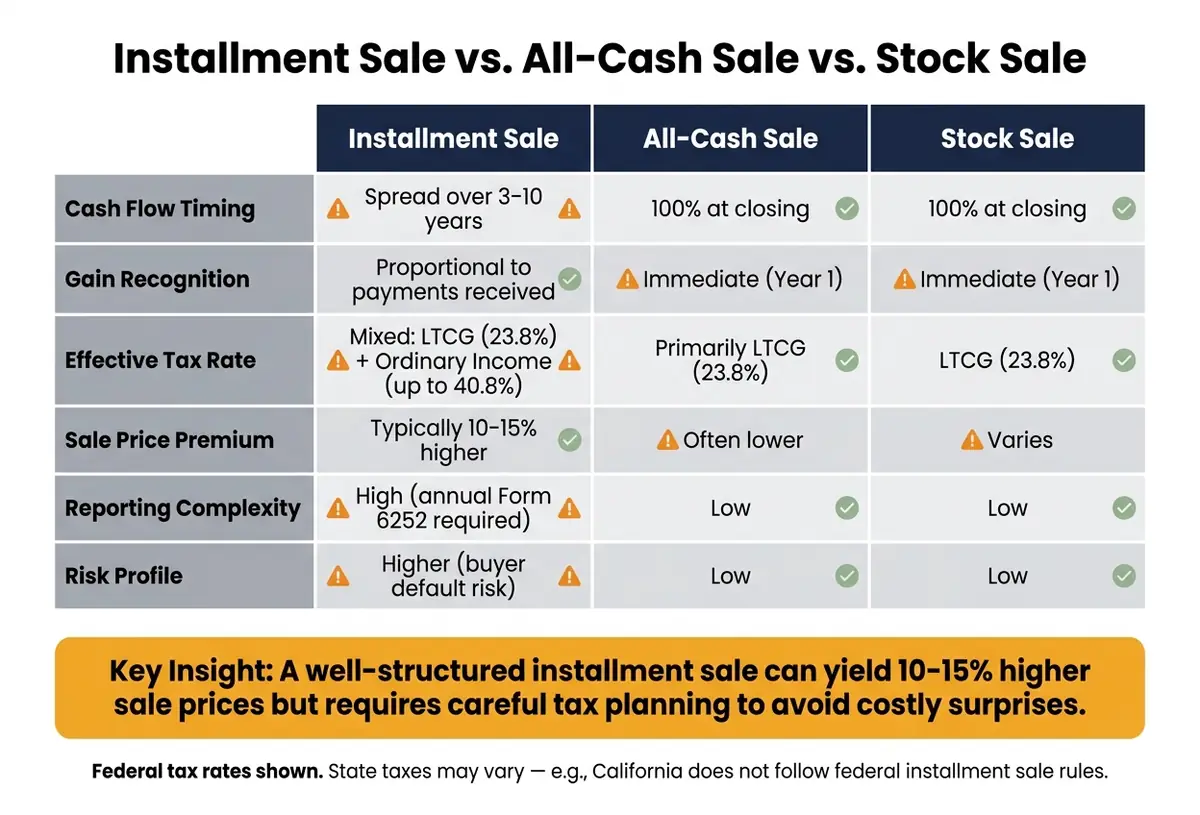
When deciding between an installment sale and other exit strategies, it's important to weigh the trade-offs in tax timing, payout, and risk. Here's a quick comparison:
| Feature | Installment Sale | All-Cash Sale | Stock Sale |
|---|---|---|---|
| Cash Flow Timing | Spread over 3–10 years | 100% at closing | 100% at closing |
| Gain Recognition | Proportional to payments | Immediate (Year 1) | Immediate (Year 1) |
| Effective Tax Rate | Mixed: LTCG + ordinary income | Primarily LTCG (23.8%) | LTCG (23.8%) |
| Sale Price Premium | Typically 10–15% higher | Often lower | Varies |
| Reporting Complexity | High (annual Form 6252) | Low | Low |
| Risk Profile | Higher (buyer default risk) | Low | Low |
The main benefit of an installment sale is the ability to spread gain recognition over multiple years, which can help you avoid higher tax brackets and reduce exposure to the Net Investment Income Tax (NIIT). However, the trade-off is the risk of buyer default. If the buyer fails to make payments, you might have to take back a business that has lost value. On the other hand, a stock sale can completely eliminate depreciation recapture and keeps gains taxed at long-term capital gains rates, but it requires a buyer willing to assume liabilities - something that can limit your pool of potential buyers.
How Clearly Acquired Helps Sellers Structure Installment Sales

Given the tax and cash flow considerations discussed above, structuring your deal properly is vital for a successful exit. Installment sales involve many moving parts - tax laws, deal terms, financing structures, and buyer evaluations. Mistakes, such as underestimating your first-year tax liability or setting the wrong interest rate, can cost you hundreds of thousands of dollars.
That's where Clearly Acquired steps in. They help sellers model the after-tax financial impact of an installment sale versus an all-cash deal before signing a Letter of Intent (LOI). Timing is everything. As Christoph Totter, Managing Partner at CT Acquisitions, explains:
"A poorly-structured $5M sale can net the same as a well-structured $4M sale. Owners who understand the tax math before they sign an LOI consistently end up with $300K–$1M+ more in their pocket."
Clearly Acquired goes beyond just the numbers. They collaborate with your CPA and M&A tax counsel to ensure your installment sale is structured to withstand IRS scrutiny. This includes addressing depreciation recapture timing and §453A interest charges on large notes. They also connect sellers with a network of over 100 capital partners, including search funders and family offices, who are often more open to using seller notes to bridge valuation gaps compared to traditional bank-backed buyers. Plus, sellers pay no advisory fees under their buyer-paid model.
The key takeaway? Start working with your advisory team 12 to 24 months before you plan to sell. Early planning allows for strategies like changing residency, restructuring your business entity, or reallocating assets - all of which can significantly impact your financial outcome. Once an LOI is signed, many of these options are no longer available, and you could miss out on substantial savings.
Key Takeaways for Business Sellers
The way you apply installment sale rules can significantly impact your final payout. To make installment sales work, you need to understand the rules inside and out. The gross profit ratio determines how much of each payment is taxable, and getting this calculation right before closing is critical. Each payment you receive is divided into three parts: a tax-free return of your basis, a capital gain, and interest income. Mistakes in these calculations can lead to expensive consequences.
One of the most common errors sellers make is underestimating depreciation recapture. According to IRC §1245 and §1250, depreciation recapture is taxed as ordinary income - at rates as high as 37% - and it's due in full during the year of the sale, regardless of how much cash you actually receive. Christoph Totter, Managing Partner at CT Acquisitions, explains:
"The IRS pretends installment sales are simple. They're not. Get the depreciation recapture wrong and the 'deferred tax' you thought you were getting becomes a $200K surprise bill in April."
Charging less than the Applicable Federal Rate can also create problems. The IRS may impute interest, which reclassifies gains as ordinary income, subject to higher tax rates. Additionally, using your installment note as collateral for another loan can trigger immediate recognition of all remaining deferred gains. And if your total outstanding installment receivables exceed $5 million, an extra §453A interest charge - about 8% as of 2026 - applies to the deferred tax liability. These complexities highlight the importance of precise planning and calculations.
"The biggest variable in your business sale isn't the headline multiple. It's the after-tax proceeds." - Christoph Totter, Managing Partner, CT Acquisitions
To maximize your after-tax proceeds, you need to start planning early - ideally 12 to 24 months before going to market. For instance, changing your state residency well in advance could save up to $665,000 in state taxes on a $5 million gain. However, this option disappears once a letter of intent (LOI) is signed. Work with a tax attorney and an M&A advisor early in the process, model after-tax outcomes under different deal structures, and ensure you have enough cash at closing to cover your initial tax obligations. Proper preparation is essential to avoid surprises and secure the best possible outcome.
FAQs
When should I opt out of installment sale treatment?
If you'd rather report all your gains upfront instead of deferring them, you might consider opting out of installment sale treatment. This can be a smart move if current tax rates are favorable or you anticipate higher rates in the future. It could also make sense if you're worried about the buyer's ability to keep up with payments or if potential risks during the transition outweigh the benefits of deferring taxes. To opt out, simply file an election using Form 6252 when submitting your tax return, making sure to do so by the due date, including any extensions.
How can I estimate my year-one tax bill if depreciation recapture applies?
When you sell a depreciated asset, depreciation recapture must be reported entirely in the year of the sale. You can't spread this amount across installment payments. The recaptured depreciation is added to your taxable income for that year. For assets falling under Section 1245, the recaptured amount is taxed as ordinary income. Meanwhile, Section 1250 properties may face a tax rate of up to 25%. It's crucial to ensure you have sufficient liquidity at the time of closing to handle this immediate tax obligation.
What are the tax implications if the buyer defaults on a seller note?
If a buyer defaults on a seller note, the tax implications hinge on how the situation is handled. With installment sales, capital gains are reported as payments come in, so a default halts any future recognition of those gains tied to principal payments. If the seller note becomes uncollectible, you might be able to claim a bad debt deduction for the remaining basis of the note. However, if you repossess business assets, this could lead to tax consequences under IRC Section 1038, which restricts the amount of gain or loss that can be recognized.
Sell with advisors who maximize your outcome
From valuation and positioning to closing the deal, we run a competitive process to get you the best terms.
About the author
Principal & CEO/CIO
Samson Jagoras has 15+ years across finance, real estate, and business acquisitions. He began his career as a Futures & Commodities broker and later served as Chief Strategy Officer of an INC 500 marketing and technology firm, helping scale revenue from $1M to over $100M. Today he buys, builds, and advises a portfolio of companies with a focus on M&A, capital allocation, and operational strategy.