How SBA 7(a) Loan Refinancing Works
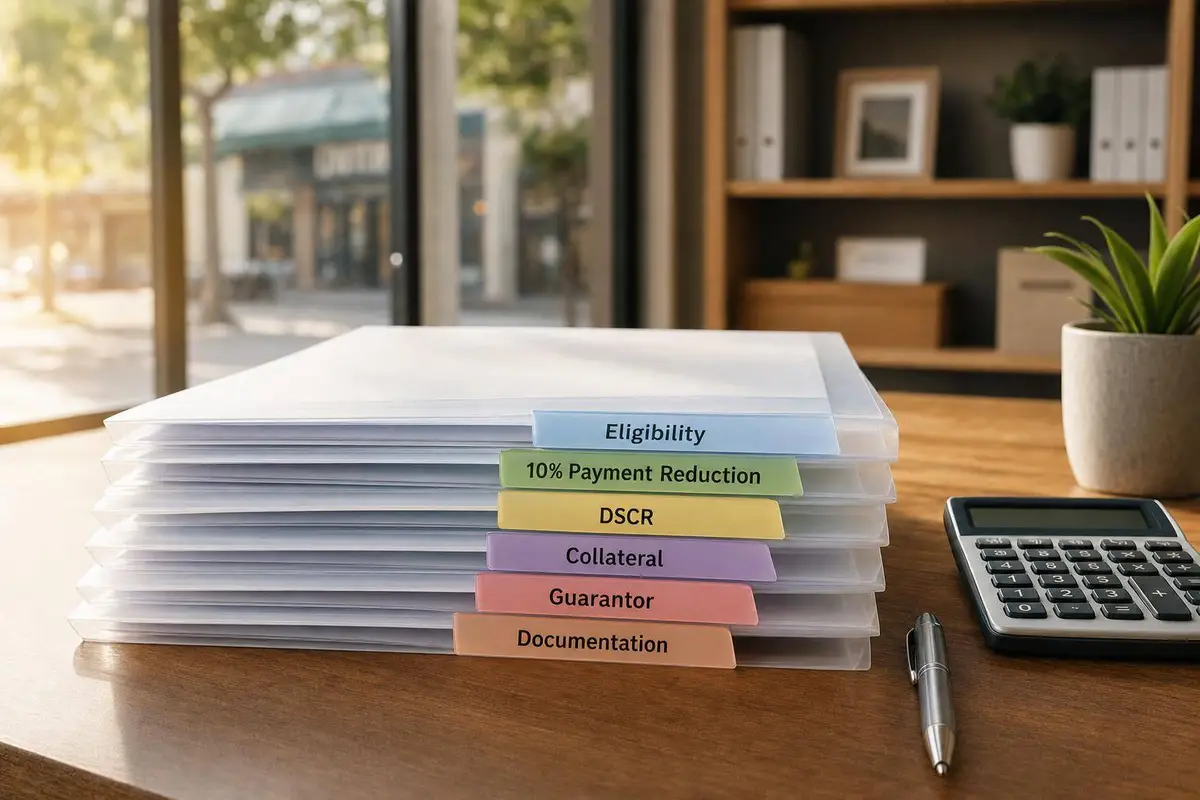
SBA 7(a) refinance essentials: eligibility, 10% payment reduction, DSCR, collateral, guarantor and documentation requirements.
 Samson JagorasPrincipal & CEO/CIOSeptember 15, 2026
Get matched with the right lender for your business
Compare offers from our vetted network. Pre-qualify in minutes — no impact to your credit.
If your business debt is expensive, short-term, or spread across too many accounts, an SBA 7(a) refinance may lower your payment and roll it into one loan. But there are hard rules: the debt must be for business use, payments usually need to be current, and the new payment must be at least 10% lower.
Here’s the short version:
- I can refinance eligible business debt only
- SBA 7(a) loans go up to $5 million
- Terms are often up to 10 years for general business debt and up to 25 years for owner-occupied real estate
- Lenders often want DSCR near 1.25x, even if SBA minimums can be lower
- Every owner with 20%+ of the business usually must give a personal guarantee
- Clean records matter: payoff letters, payment history, tax returns, lien details, and proof of original use of funds
Before I apply, I’d check three things first:
-
Does the debt qualify?
The lender will trace where the money went. Mixed personal and business use can stop the deal. -
Will the refinance pass the payment test?
The new payment usually needs to be at least 10% lower than the debt being replaced. -
Will underwriting work?
Cash flow, collateral, credit, and lien position still need to hold up.
A refinance like this is less about “getting a new loan” and more about proving the old debt fits SBA rules and that the new structure puts the business in a better payment position.
Your Guide to Mastering SBA 7a Refinance Options to Maximize Your Business Growth

sbb-itb-a3ef7c1
SBA 7(a) Refinance Eligibility Rules to Clear Before Applying
Before a lender even looks at cash flow or collateral, the debt has to clear the SBA’s refinance rules. This is the first filter. If the loan doesn’t pass here, the file usually doesn’t move much further.
The main tests are pretty simple on paper: the debt must be for a business purpose, the original proceeds must have gone to an eligible use, payments must be current, the refinance can’t shift a likely loss onto the SBA guaranty, and the new payment must be at least 10% lower than the debt being replaced, a key requirement when comparing SBA 7(a) loan terms vs. other financing options.
Eligible Debt, Ineligible Debt, and the Business-Purpose Test
Lenders don’t just take your word for it. They trace the original loan proceeds to make sure the money went to business expenses, not personal ones. That usually means checking account history, invoices, purchase contracts, and bank statements.
Some cases are easy. A working-capital loan used only for payroll and inventory is usually clean. Mixed-use debt is where things get messy. If a note covered a business tax bill and a personal expense, the personal portion is usually not eligible. In some cases, that piece has to be separated before the rest can be refinanced.
| Debt Type | Eligible for SBA 7(a) Refinance? | Key Notes |
|---|---|---|
| Term loan (business-purpose, documented) | Generally yes | Must confirm original proceeds funded eligible uses |
| Business line of credit converted to term debt | Generally yes | Draws must be documented as business expenses |
| Equipment loan tied to business assets | Generally yes | Equipment must be for business use; lien position is reviewed |
| Merchant cash advance (MCA) | Requires lender review | Lender must review the structure and repayment terms, and whether it functions as business debt |
| Debt with personal-use proceeds | Generally no | Personal portions are ineligible, and mixed-use debt creates documentation problems |
| Business-purpose HELOC or credit card | Eligible if documented as business use | Borrower must certify draws were used exclusively for business expenses |
Seasoning, Payment History, and SBA-to-SBA Refinance Rules
Lenders usually look at the last 12 months of payments. No payment can be more than 29 days late, and no matured balance can stay unpaid more than 29 days past maturity. So even if a loan is current today, a 30-day late mark from six months ago can still cause trouble. Underwriting looks at the pattern, not just the snapshot.
If you’re refinancing one SBA loan with another SBA 7(a) loan, expect added review. The current SBA loan usually needs to be seasoned for at least 12 months, and the borrower must show a documented, material benefit. In most cases, that means a lower payment or better cash flow. It’s allowed, but lenders look at it carefully.
Use these rules to screen the debt before asking for payoff figures.
A Pre-Application Checklist Before You Contact a Lender
This is a practical way to pre-screen the debt before sending a package to a lender. It might take an hour. That hour can save weeks of emails, missing documents, and “one more thing” follow-ups.
| Criterion | Requirement |
|---|---|
| Purpose of each debt | Business use only; personal proceeds make the debt partially or fully ineligible |
| Original use of proceeds | Must have financed an eligible business purpose such as equipment, working capital, leasehold improvements, or owner-occupied commercial real estate - ineligible original use disqualifies the debt regardless of current status |
| Current balance and rate | Documented with lender statements; needed to model the new payment and confirm borrower benefit |
| Remaining term | Confirmed with payoff schedule; affects amortization comparison and payment reduction calculation |
| Payment history (last 12 months) | No payments 30+ days past due; no matured unpaid balances - recent delinquency can make the debt ineligible outright |
| Collateral securing the debt | Identify assets and existing lien holders; lender needs to assess lien position and collateral availability |
| 10% payment reduction test | New combined payment must be at least 10% lower than existing payments - failing this test is a common early disqualifier |
| Loss-shift risk | Refinance cannot move an existing or likely loss onto the SBA guaranty - SBA will not guarantee a bailout of a distressed obligation |
If the debt clears these checks, lenders usually move on to cash flow, collateral, and guarantor review.
How Lenders Underwrite an SBA 7(a) Refinance
Once a debt passes the eligibility screen, the lender shifts to a more practical question: does this refinance still make sense on paper? That usually comes down to cash flow, collateral, and the people backing the loan.
Cash Flow, DSCR, and the 10% Payment-Reduction Test
Lenders usually start with payment relief. They want to see that the refinance does what it’s supposed to do: lower the burden on the business.
The payment-reduction test checks whether the new SBA loan payment is at least 10% lower than the current combined payment on all debts being refinanced. If the new payment doesn’t clear that bar, many lenders will push back right away.
Then comes DSCR, or debt service coverage ratio. This is where underwriters look past the monthly payment and ask whether the business can handle the new loan over time. They compare normalized cash flow with total annual debt service on the new loan, plus any debt that will stay in place. That cash flow figure often includes addbacks for depreciation, amortization, owner compensation changes, and documented one-time expenses.
Most SBA lenders want to see DSCR around 1.25x or better, even though SBA minimums are lower: 1.15x for standard loans and 1.10x for Small Loans.
These are two separate checks. A deal can pass the 10% payment test and still fall apart on DSCR if cash flow is thin. Underwriters also often review combined coverage, including guarantor debt obligations. On top of that, many lenders run a 10% stress test on projected cash flow to see if coverage still holds under some pressure.
If the numbers work, the lender moves on to the collateral package and the guarantors.
Collateral, Lien Position, and Guarantor Review
After cash flow, lenders look at what secures the loan and who stands behind it.
In most cases, the lender files a blanket UCC-1 lien on all available business assets and tries to get a first-position lien when possible. If real estate is part of the deal, the structure often includes a mortgage or deed of trust. For loans over $500,000, lenders must seek full collateral support. That can mean taking a lien on personal real estate if business assets by themselves don’t cover the loan amount.
They also run UCC searches to spot existing liens that could interfere with the SBA lender’s position or that need to be paid off and released at closing. This step matters more than many borrowers expect. A hidden filing from an old lender can slow the whole deal down.
Personal guarantees are also required. Every owner with 20% or more equity in the business must sign an unlimited personal guarantee. Lenders review personal financial statements, personal tax returns, and personal credit reports for each guarantor. They’re looking at net worth, debt load, credit score, and any red flags like late payments, collections, tax liens, or past bankruptcies.
| Underwriting Factor | Common Benchmark |
|---|---|
| DSCR (standard loans > $350,000) | 1.15x SBA minimum; many lenders look for about 1.25x |
| DSCR (Small Loans ≤ $350,000) | 1.10x SBA minimum; many lenders still prefer about 1.25x |
| Monthly payment reduction | At least 10% |
| Personal guarantee | Required for all 20%+ owners |
| Lien position | Lien on all available business assets; first position where possible |
Clearly Acquired can help organize debt schedules, normalize financials, and flag lien or document issues before underwriting starts.
If the file passes these checks, the lender moves to payoff figures, closing documents, and funding.
Step-by-Step: How to Refinance Existing Business Debt with an SBA 7(a) Loan

SBA 7(a) Loan Refinancing: Step-by-Step Process & Key Requirements
Once you know the debt is eligible, this turns into a paperwork and payoff process. The faster path usually comes down to one thing: showing up organized.
Step 1: Build a Debt Schedule and Confirm Refinance Eligibility
Start with a debt schedule. Your lender will use it to check balances, payoff amounts, and which debts can be refinanced.
For each obligation, list the lender name, type of facility, original use of proceeds, current balance in U.S. dollars, interest rate, monthly payment, remaining term, pledged collateral, and current status. That status should include any 30-, 60-, or 90-plus-day delinquencies.
It also helps to label each debt as eligible, ineligible, or mixed-use. That makes it easier for the lender to trace each item. If one loan refinanced an older loan, mark that too, because the lender may need to trace the original use of funds. And if any debt is already SBA-backed, call that out on its own since it falls under extra refinance rules.
Once the schedule is clean, the next step is to test the payment and get the file ready for the lender.
Step 2: Model the New Payment and Prepare the Lender Package
Before you submit anything, run the numbers.
Add up the current monthly payments for every debt you want to refinance. Then use that schedule to see whether the new loan passes the SBA benefit test. When you model the refinance, include prepayment penalties, financing fees, and any SBA recoupment fee that applies in the total refinance amount.
It’s smart to test a few term options before sending the file in. A small shift in amortization can change payment relief by a lot. After that, check DSCR using the post-refinance debt service so you know the projected payment still fits lender underwriting.
If the math holds up, put together the lender package. Include:
- Existing loan notes and agreements
- Formal payoff statements from current lenders, including per diem interest and wire instructions
- 12-month payment history for each debt being refinanced
- 2–3 years of business and personal tax returns
- Year-to-date profit & loss statement and balance sheet
- Updated debt schedule
- SBA Form 1919 (Borrower Information Form)
- SBA Form 413 for each owner with 20% or more equity
- Entity documents such as articles of incorporation or organization, operating agreement, and EIN
- Collateral records, including UCC filings, equipment lists, appraisals, and insurance
A complete package up front can shorten underwriting and lower the odds of getting stuck in conditional approval. Clearly Acquired can help borrowers standardize these materials using AI-driven workflows before the file goes to underwriting.
If the file is complete and the payment model works, it should move into underwriting and payoff prep.
Step 3: Move Through Underwriting, Payoff, and Closing
At this stage, the lender is working to verify the file, approve the credit, and close the payoff. For a clean deal with a Preferred Lender Program (PLP) bank, the full path from complete application to funding usually takes 60–90 days. More complicated files can take longer.
| Process Phase | What the Lender Reviews | Typical Timeline |
|---|---|---|
| Initial screening & prequalification | High-level financials, credit scores, basic debt schedule, rough DSCR and 10% payment-reduction feasibility | 1–2 weeks |
| Full application & document collection | SBA forms, business and personal tax returns, YTD financials, detailed debt schedule, collateral info, eligibility review | 1–3 weeks |
| Underwriting & credit memo | Detailed cash-flow analysis, DSCR, payment-reduction test, collateral and lien positions, guarantor strength, risk rating | 2–6 weeks |
| Credit approval & SBA authorization | Internal credit committee; SBA authorization in-house for PLP lenders, SBA review for non-PLP | 1–3 weeks |
| Closing preparation | Loan and security documents drafted, payoff letters obtained, UCC lien searches, insurance and landlord consents verified | 1–3 weeks |
| Closing & funding | Documents signed, funds disbursed via escrow to pay off existing lenders, the new payment schedule begins | 1–5 business days |
These timelines are common for SBA-focused lenders, but the actual timing depends on the lender, the collateral, and how messy or clean the file is.
At closing, the new SBA lender sends the proceeds straight to your current creditors based on formal payoff letters, not to you. The closing agent wires the payoff funds directly to the existing lenders. After that, make sure UCC termination filings or mortgage reconveyances are recorded so the new lender’s secured position is documented. Once that’s done, you’re left with one SBA loan and a new payment schedule.
Common Underwriting Problems and Final Takeaways
Problems That Commonly Delay or Kill Approval
Once a borrower clears the basic eligibility checks, underwriting usually falls apart for a short list of familiar reasons.
Weak cash flow is the issue lenders run into most often. In many cases, they want to see DSCR at about 1.10x to 1.15x after the refinance. If the numbers are too tight, the file can stall fast.
Mixed-use debt is another common snag. Underwriters need to split business and personal use of proceeds, and when that paper trail is missing, the debt may not qualify at all.
There’s also the payment-relief test. If the new loan setup doesn’t materially improve the payment, lenders may turn it down because it fails that standard.
Then there are collateral issues. Unresolved tax liens, hidden UCC filings, or a weak lien position can slow down closing or stop the deal altogether.
A weak payment history can also hurt the file, especially if there are recent delinquencies or a prior SBA loss. That tends to push the risk level up and can lead to denial.
What to Do Before Submitting an Application
The good news is that most of these issues can be avoided if the file is cleaned up before submission.
Start with the debt schedule. It should match the liabilities listed on the business balance sheet and the most recent tax returns. Every loan, line of credit, and equipment obligation needs to line up. It also helps to pull a 12-month payment history and confirm the current balance for each debt being refinanced.
Next, track down the original note and closing documents for each obligation. Those records should show how the proceeds were used. If some documents are missing, gather the strongest proof you can that the funds were used for business purposes.
Financial statements matter too. Profit and loss, balance sheet, and cash flow statements should be current, consistent with each other, and in line with filed tax returns. If one document says one thing and another says something else, underwriting will almost always ask questions.
When these records are in order from the start, the file tends to move through underwriting with fewer conditions and less back-and-forth.
Key Points to Remember
These five items drive a big share of approval decisions:
| Condition | What Lenders Need to See |
|---|---|
| Eligible debt | Business-purpose use of proceeds, documented with original notes |
| Borrower benefit | At least 10% reduction in monthly or annual payment |
| Sufficient cash flow | DSCR at or above about 1.10x–1.15x after refinance |
| Clean collateral | Matching or equivalent lien position, no unresolved liens |
| Complete documentation | Tax returns, payment history, payoff letters, original notes |
Borrowers usually move fastest when the file is ready before the lender has to ask for anything.
FAQs
Can I refinance mixed-use debt?
Possibly - if the debt qualifies for SBA 7(a) refinancing and the new loan follows SBA rules.
In most cases, lenders look for:
- a 650+ credit score
- a DSCR of 1.15x to 1.25x
- at least 12 months of on-time payments
- a 10% drop in monthly debt payments
Debt that may qualify includes bank loans, SBA loans, equipment loans, lines of credit, and some seller notes.
Merchant Cash Advances usually don't qualify.
What if I have late payments in my payment history?
Late payments can cause problems. Lenders usually want to see 12 months of on-time payments on the debt you want to refinance. They’ll also review your financials, credit score, and DSCR.
If those late payments are recent or happen often, getting approved can be tougher. That’s even more likely if your DSCR is weak or the refinance doesn’t cut your payment by at least 10%.
How long does SBA 7(a) refinancing usually take?
It depends on the lender’s underwriting process and how complete your paperwork is. In most cases, lenders review your financial statements, tax returns, debt schedules, cash flow, payment history, and SBA eligibility before they approve the loan.
Delays usually happen when a business doesn’t meet DSCR requirements, doesn’t have two years of financial records, or has missing documents. Once the loan is approved, the lender will usually pay off the current debts directly.
Related Reading
Find the right lender for your business
Whether it's working capital, an SBA loan, or acquisition financing — we'll match you with the right capital partner.
About the author
Principal & CEO/CIO
Samson Jagoras has 15+ years across finance, real estate, and business acquisitions. He began his career as a Futures & Commodities broker and later served as Chief Strategy Officer of an INC 500 marketing and technology firm, helping scale revenue from $1M to over $100M. Today he buys, builds, and advises a portfolio of companies with a focus on M&A, capital allocation, and operational strategy.