Cambridge Savings buys First Seacoast Bancorp
Cambridge Savings Bank to acquire First Seacoast Bancorp for $80.9M in an all-cash deal, adding five New Hampshire branches; closing expected Q3 2026.
 Samson JagorasPrincipal & CEO/CIOMay 15, 2026
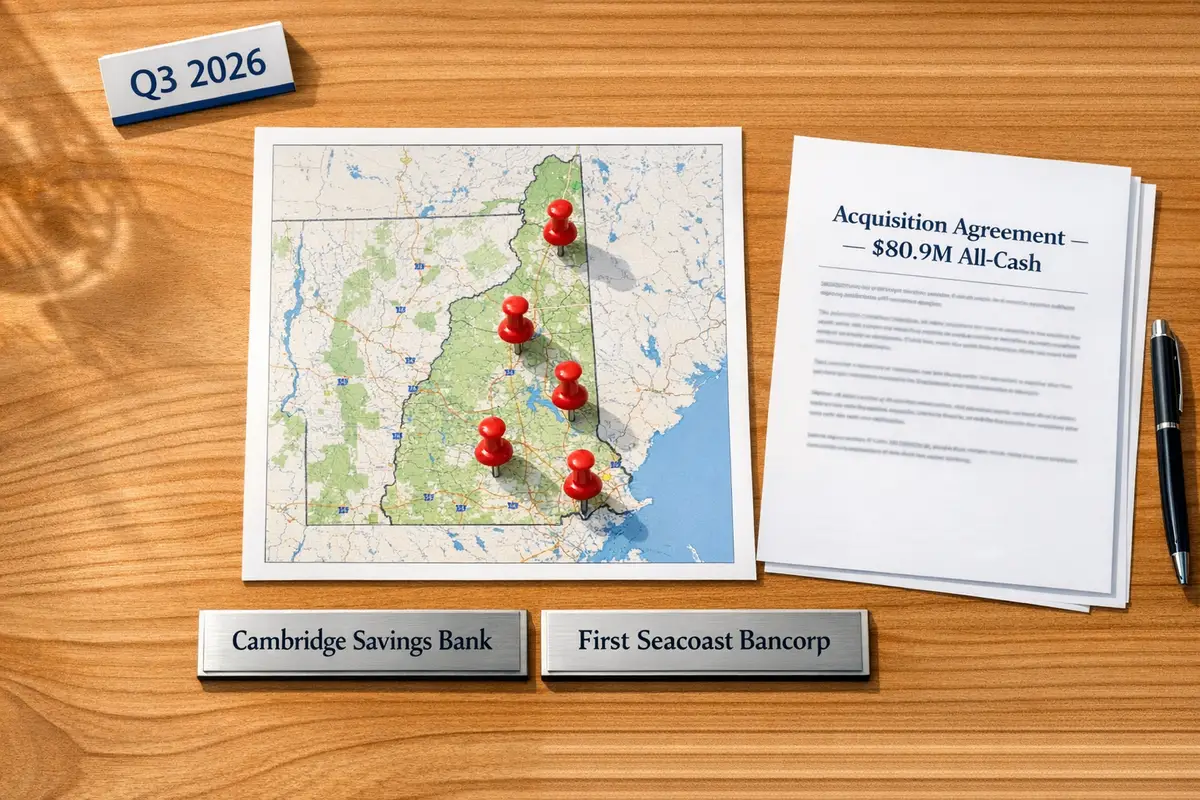
First Seacoast Bancorp Jumps on $80.9M Buyout Deal
Cambridge Financial Group, the parent company of Cambridge Savings Bank, has announced an $80.9 million all-cash acquisition of First Seacoast Bancorp. Shareholders will receive $17.25 per share, with the deal expected to close in Q3 2026, pending regulatory and stockholder approvals.
Key Details
- Expansion: Cambridge will enter New Hampshire's Seacoast region, adding 5 branches and growing its network to 24 locations.
- Financing: The deal is funded entirely through Cambridge's $703.5 million equity capital.
- Market Impact: This marks the fifth major out-of-state bank acquisition in New Hampshire, with Massachusetts banks now controlling 7.75% of the state's deposits.
- Stakeholders: First Seacoast shareholders gain a cash payout, while Cambridge strengthens its regional presence.
This move reflects a growing trend of mutual savings banks using cash reserves for acquisitions to scale operations and expand into new markets.
Cambridge Bancorp Acquires First Seacoast: $80.9M Deal Overview
1. First Seacoast Bancorp Buyout Deal
Deal Structure and Terms
Cambridge has agreed to an all-cash acquisition of First Seacoast Bancorp at $17.25 per share, valuing the deal at approximately $80.9 million. Unlike many bank mergers that involve a mix of stock and cash, Cambridge — a mutual savings bank — is legally required to use cash reserves exclusively for such transactions. The agreement includes a $3.5 million termination fee, which First Seacoast would owe if the deal falls through under specific conditions. To further ensure the deal's completion, directors and executive officers of First Seacoast have already signed voting agreements in favor of the merger. The transaction still requires regulatory approval and a green light from stockholders, with the closing anticipated in the third quarter of 2026. This carefully structured deal reflects Cambridge's focus on strategic growth, as outlined below.
Strategic Rationale Behind the Acquisition
Cambridge has been preparing for this kind of opportunity, increasing its equity capital by 16% to $703.5 million by the end of 2025 to support acquisitions. Cambridge CEO Ryan Bailey highlighted the timing and strategic fit of the deal:
"We built our capital to find the right deal at the right time, and this opportunity allows us to advance our community banking reach into a growing region of New England."
For First Seacoast, which reported a net loss of $845,000 over the last year, the merger offers a lifeline. By joining forces with Cambridge, First Seacoast gains access to a $7 billion asset base and advanced technology, enabling better service for local businesses and communities. This merger not only expands Cambridge's market footprint but also delivers meaningful benefits to customers, employees, and shareholders alike.
Stakeholder Impact
The deal provides First Seacoast shareholders with a clear cash payout, while customers can look forward to uninterrupted service. Cambridge has committed to keeping all five First Seacoast branches open, integrating them into its existing network. This move strengthens Cambridge's balance sheet and adds to its branch network, which will grow from 19 to 24 full-service locations. Importantly, the acquisition marks Cambridge's entry into New Hampshire's Seacoast region, broadening its reach in the area.
Financing Approach
Cambridge funded the $80.9 million purchase entirely through its accumulated equity capital, a characteristic approach for mutual savings banks that rely on cash reserves rather than stock-based transactions. Piper Sandler & Co. served as the financial advisor for Cambridge, while Keefe, Bruyette & Woods advised First Seacoast and provided a fairness opinion on the deal. This financing strategy underscores Cambridge's commitment to steady, cash-driven growth. The acquisition is a rare example of a mutual savings bank purchasing a publicly traded stock bank, showcasing how disciplined capital management can support strategic expansion in a competitive market.
2. 2025–2026 SMB Bank M&A Trends
Deal Structure and Terms
The 2025–2026 period highlights a noticeable move toward all-cash transactions, especially among mutual savings banks that are limited to cash-only deals. Over time, mutual holding companies have been building their equity capital, preparing for strategic acquisitions when the right opportunities arise. Interestingly, the once-rare mutual-to-stock acquisition structure is becoming more common. A clear example of this is Cambridge's acquisition of First Seacoast Bancorp.
This trend isn't isolated to Cambridge. In November 2025, Eastern Bankshares, based in Boston, acquired HarborOne Bancorp of Brockton for $490 million. Additionally, Berkshire Hills Bancorp merged with Brookline Bancorp in a $1.1 billion deal in September 2025. These transactions underscore how larger Massachusetts-based banks are consolidating smaller New Hampshire community banks to expand their presence in the Seacoast region. As a result, Massachusetts banks now control 7.75% of all deposits in New Hampshire. These evolving deal structures are shaping the future of banking consolidation, with a focus on scale and technological advancement.
Strategic Rationale Behind the Acquisition
The driving forces behind mergers in this timeframe are scale and technology. Smaller community banks often struggle to compete because they lack the capital to invest in cutting-edge digital banking platforms and infrastructure. By merging with larger institutions, these banks gain access to modern technology while retaining their hallmark local, relationship-driven service — an advantage for both customers and regulators.
Geographic expansion is another key motivator. Instead of consolidating solely within their existing territories, banks are increasingly stepping across state borders to enter growing economic hubs. For instance, the Cambridge–First Seacoast deal demonstrates this trend, with a $7 billion Massachusetts bank acquiring a $600 million New Hampshire bank to establish a presence in a new market. This strategy not only amplifies scale but also enhances value for customers and shareholders alike.
Stakeholder Impact
These acquisitions come with immediate benefits for stakeholders. For instance, after the buyout announcement, First Seacoast Bancorp's stock price jumped 41% during premarket trading, offering shareholders a clear cash exit at $17.25 per share. Customers also gain from an expanded branch network and improved digital banking services while continuing to receive the personalized community banking experience they value. Additionally, commitments to keep all five First Seacoast branches operational ensure continuity and stability for local customers.
Financing Approach
Unlike stock-for-stock deals often favored by publicly traded companies, mutual banks during this period are leveraging their accumulated equity to fund all-cash transactions. For example, Cambridge utilized its built-up capital to finance the entire $80.9 million purchase. This disciplined, cash-focused approach is reshaping the banking landscape in New England, emphasizing financial stability and deliberate growth.
Ready to Make Your Next Move?
Whether you're buying, selling, or investing — Clearly Acquired gives you the tools, data, and support to close with confidence.
M&A Deal Analysis and Valuation: Pros and Cons
The Cambridge–First Seacoast deal brings both advantages and challenges, offering insights into the dynamics of small and mid-sized bank (SMB) mergers and acquisitions in 2025–2026. By analyzing this $80.9 million all-cash transaction, we can better understand its implications in the broader context of banking trends during this period.
| Aspect | Pros | Cons |
|---|---|---|
| Payment Structure | The all-cash payment at $17.25 per share ensures immediate liquidity and certainty for First Seacoast shareholders. | Shareholders miss out on any potential future equity gains. |
| Market Strategy | Cambridge gains its first foothold in New Hampshire's Seacoast region, expanding its geographic presence. | Entering a new state comes with integration hurdles and unfamiliar market conditions. |
| Branch Network | All five First Seacoast branches remain operational, preserving local banking services. | With assets around $600 million, the deal lacks the technology investment opportunities seen in larger mergers over $1 billion. |
| Deal Execution | Cambridge Savings Bank's strong equity base of $703.5 million supports the financial stability of a cash-only acquisition. | Regulatory and shareholder approvals may introduce delays or uncertainties. |
A termination fee offers some protection if the merger doesn't proceed. However, this deal, at roughly one-tenth the size of larger transactions like Eastern Bankshares' $490 million acquisition of HarborOne, underscores the limitations smaller banks face in competing with larger players, particularly in technology and scalability.
While the all-cash structure avoids the risk of shareholder dilution, it also means First Seacoast shareholders completely exit the investment, giving up any potential for long-term equity gains. This trade-off — between immediate financial certainty and the chance for future growth — is a hallmark of mutual-to-stock acquisitions.
Conclusion
The $80.9 million acquisition of First Seacoast Bancorp by Cambridge Savings Bank highlights the impact of careful financial planning in successful small and medium-sized business (SMB) deals. By steadily building its equity capital over two years, Cambridge positioned itself to execute an all-cash transaction when the right opportunity arose. This serves as a valuable reminder for entrepreneurs and investors: maintaining strong financial reserves allows for swift and confident decision-making when the market aligns with growth ambitions.
This acquisition also reflects a broader trend of market consolidation. Massachusetts-based banks now control 7.75% of all New Hampshire deposits, following a series of regional mergers. Cambridge's expansion into the Seacoast region aligns with the banking industry's growing focus on geographic diversification and technology-driven growth. As Ryan Bailey, CEO of Cambridge Savings Bank, explained:
"We built our capital to find the right deal at the right time, and this opportunity allows us to advance our community banking reach into a growing region of New England."
For business buyers, this deal underscores the importance of focusing on cultural alignment and maintaining operational stability. Cambridge has pledged to keep all five First Seacoast branches open, ensuring continuity in local banking services. This commitment strengthens community trust and supports customer retention, even as the bank works to address First Seacoast's $845,000 net loss over the past year. The all-cash structure of the deal further reinforces confidence in its strategic soundness while paving the way for operational improvement.
Additionally, the merger offers opportunities for long-term value creation. With Cambridge's larger resources, the combined institution is better positioned to invest in technology and achieve operational efficiencies — areas where smaller banks often face challenges. For SMB buyers, the key takeaway is clear: prioritizing strategic alignment and future growth potential can deliver more enduring benefits than focusing solely on immediate financial results.
FAQs
What approvals could delay or stop this deal?
Regulatory and shareholder approvals are key factors that could potentially delay or even halt this deal. These steps are essential to make sure the transaction aligns with both legal standards and the organization's internal protocols.
What changes will First Seacoast customers notice after the merger?
Customers of First Seacoast can rest assured that their banking experience will remain unchanged for now following the merger. The bank remains committed to providing personalized service and staying deeply involved in the community, ensuring the transition is smooth and uninterrupted.
Why are mutual banks doing more all-cash acquisitions now?
Mutual banks are turning more frequently to all-cash acquisitions since they lack the ability to issue stock as payment. As a result, maintaining healthy cash reserves has become a top priority. Take Cambridge Savings Bank, for instance — they spent two years strengthening their equity capital to prepare for their $80.9 million all-cash acquisition of First Seacoast Bancorp. This approach underscores the importance of liquidity and financial adaptability for mutual banks aiming to expand without relying on stock issuance.
About the author
Principal & CEO/CIO
Samson Jagoras has 15+ years across finance, real estate, and business acquisitions. He began his career as a Futures & Commodities broker and later served as Chief Strategy Officer of an INC 500 marketing and technology firm, helping scale revenue from $1M to over $100M. Today he buys, builds, and advises a portfolio of companies with a focus on M&A, capital allocation, and operational strategy.