The 2026 Stanford Search Fund Study: What the Data Says About One of the Market's Most Overlooked Asset Classes
The 2026 Stanford Search Fund Study reports a 33.9% aggregate IRR and 4.75x ROI across 862 funds. Here's what the data means for investors — and how to access the asset class.
 Samson JagorasPrincipal & CEO/CIOJuly 1, 2026
Invest in profitable Main Street businesses
Create your investor profile to access curated deal flow, co-investment opportunities, and the Catalyst Fund.
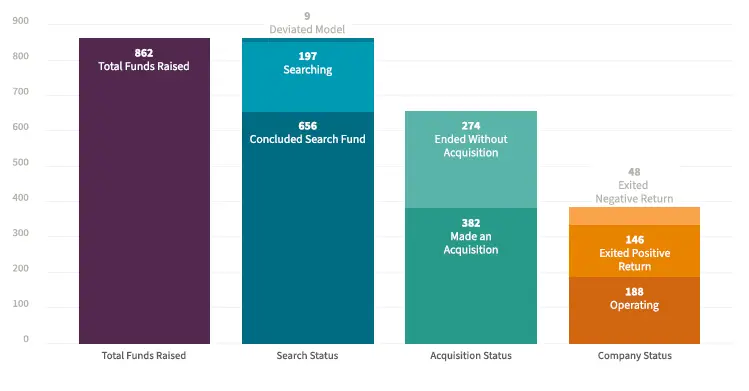
Every two years, the Stanford Graduate School of Business publishes the definitive dataset on search funds — the entrepreneurial model where an operator raises capital to find, acquire, and lead a single small business. The 2026 Search Fund Study is the largest edition yet, tracking 862 core search funds launched since 1984, representing roughly 99% of all known search funds in the United States and Canada.
For investors, the headline is simple and hard to ignore: as of December 31, 2025, the entire universe of search funds generated an aggregate IRR of 33.9% and a 4.75x return on invested capital — figures that have stayed remarkably durable across four decades and multiple economic cycles.
This article breaks down what the 2026 study actually found, why entrepreneurship through acquisition (ETA) belongs on the radar of serious allocators, and how Clearly Acquired gives investors a structured, vetted way to access the asset class — including through Catalyst Fund I, which is open now.
Get the data. Download our copy of the 2026 Stanford Search Fund Study to read every figure, exhibit, and cohort breakdown for yourself.
⬇ Download the 2026 Stanford Search Fund Study (PDF)What Is a Search Fund? A Quick Primer
The model Stanford has tracked since 1984 is the traditional search fund — a two-stage vehicle built around a single entrepreneur (or a pair of partners):
- The search phase. Investors fund a modest pool of capital — in the most recent cohort, a median of about $550,000 per principal — effectively paying the searcher a stipend to spend one to two years sourcing, screening, and negotiating the acquisition of an established, profitable company.
- The acquisition phase. Once the searcher signs a letter of intent and completes diligence, the original investors get the right to fund the purchase. The searcher becomes CEO and runs the business, aiming to grow cash flow and eventually exit through a sale or recapitalization.
This is the umbrella known as entrepreneurship through acquisition (ETA) — a category that sits in the gap between venture capital (betting on unproven startups) and traditional private equity (buying larger companies at higher multiples). ETA targets durable, cash-generating businesses in the lower middle market: home and commercial services, B2B software, healthcare services, education, and niche manufacturing.
But traditional search — where investors pay an operator to go looking — is only one way into the asset class, and it isn''t the one Clearly Acquired uses. We invest in self-funded searchers and independent sponsors instead — structures with even tighter alignment between operator and investor. We explain exactly how, and why it matters, below.
The typical searcher in the 2024–25 cohort was 32 years old, held an MBA (80%), and came from consulting, private equity, or finance. Just over a third searched with a partner — a structure the data repeatedly links to better outcomes.
The 2026 Stanford Search Fund Study: Key Findings for Investors
Here is what the newest edition of the study tells us, distilled into the numbers that matter most to anyone deploying capital.
1. The aggregate returns remain exceptional
Across all 862 funds — including unsuccessful searches, companies still operating, and every exit (good and bad) — the study reports:
- 33.9% aggregate IRR
- 4.75x aggregate ROI
These are blended, warts-and-all numbers. They include searchers who never bought a company and companies that lost money. IRR ticked down slightly from the 2024 study (35.1%), while ROI rose (from 4.5x) because CEOs are holding companies longer and compounding value.
Narrow the lens to funds that acquired and exited, and returns climb to a 39.3% IRR and 5.98x ROI.
2. Search funds have meaningfully outperformed the S&P 500
To put those returns in context, Stanford calculates a public market equivalent (PME) — what the same capital would have earned in the S&P 500 over the identical holding period. A PME of 1.0 equals the index; above 1.0 means outperformance.
- Overall PME: 2.88 — nearly 3x what public markets returned over the same windows.
- Exited-fund PME: 3.59.
In other words, on a like-for-like, time-matched basis, the search fund asset class has historically delivered close to triple the S&P 500''s result.
3. This is a "cash flow, not sentiment" asset class
Search funds buy real operating businesses — the plumbing contractor, the specialty distributor, the regional healthcare services provider. Their value is driven by operational performance and local demand, not by public-market mood swings, interest-rate headlines, or algorithmic trading.
That''s why local essential services, trades, and light manufacturing tend to move independently of public-market volatility. For an allocator, that low correlation is the point: exposure to durable Main Street cash flow that doesn''t rise and fall with the ticker tape, and that can''t be automated away.
(Note: the Stanford study measures performance versus the S&P 500 via PME; it does not publish a formal correlation coefficient. Low correlation is a widely recognized structural characteristic of privately held operating businesses, not a guarantee.)
4. Acquisition activity is normalizing after a boom
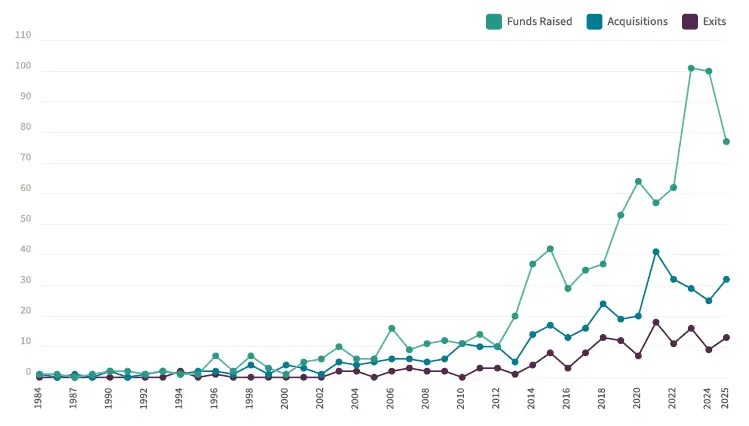
New search fund launches peaked in 2023 and stayed historically high through 2025. But acquisition rates for the newest cohorts have cooled: 58% of all concluded funds have acquired a company historically, versus about 48% for funds that launched in 2021–24. Stanford attributes roughly half of the recent decline to tougher market conditions and increased competition, and half to a wider range of preparedness as the model has gone mainstream.
The takeaway for investors is not "returns are falling." It''s that the gap between prepared, well-supported searchers and everyone else is widening — which is exactly where deal selection and operator quality earn their keep.
The Part Every Investor Needs to Understand: The Power Law
Here is the single most important insight in the 2026 study, and the one that separates sophisticated allocators from tourists.
Search fund returns follow a power law. A small number of outlier winners drive the overwhelming majority of aggregate returns:
- Strip out the funds that returned 10x or more, and the aggregate falls from 4.75x to 2.8x ROI (and from 33.9% to 27% IRR).
- Strip out just the top 10% of funds by ROI, and it drops further to 2.1x ROI and 20% IRR.
Read that again. The blended 4.75x that makes headlines is real — but it is not what you get by buying "the average deal." You get it by having exposure to the winners. And the winners are not random: the study found that top-decile funds tended to be older vintages that bought smaller companies at disciplined prices, backed by experienced, often partnered operators.
This is why access and selection are everything. The historical returns of the asset class are only available to investors who can:
- Get into vetted, high-quality deals — not whatever is left over.
- Back great operators — the study repeatedly shows experience, partnership, and early deal momentum predict success.
- Achieve diversification across enough deals to capture the winners, since any single acquisition is binary.
An investor who backs a single deal is making a coin-flip bet. An investor with a diversified, professionally selected portfolio is buying the shape of the whole distribution.
What the Data Says Actually Drives Returns
The 2026 study identifies clear, repeatable factors correlated with higher IRR, ROI, and PME. For anyone evaluating a deal — or a fund that assembles them — this is the checklist:
- High recurring revenue. Predictable cash flows give operators stability and time to improve the business. Strongly associated with higher returns.
- Sensible leverage. Companies with debt at acquisition (funded by understandable, predictable profits) outperformed all-equity deals — the classic benefit of leverage on equity returns.
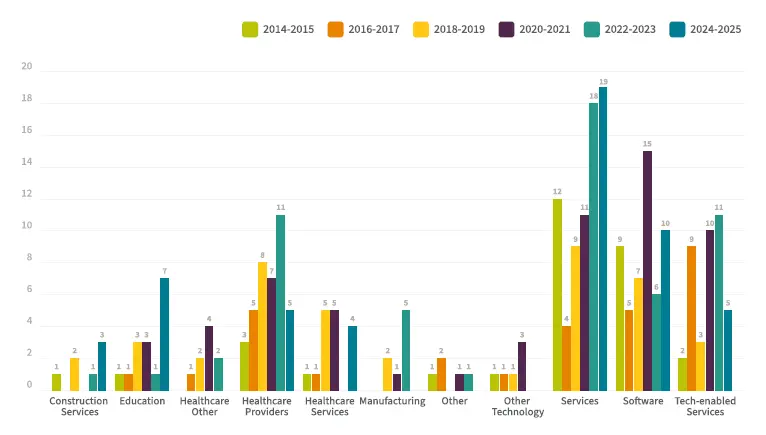
- Services businesses. The most common — and among the highest-returning — category, followed by software.
- Partnered searches. Two operators consistently beat solo searchers on both acquisition rate and returns. In the 2021–24 cohort, partnered searchers acquired at 58% versus 43% for solo.
- Experienced operators with early momentum. Searchers with more than two years of post-graduation experience acquired at 55% (vs. 40% for the least experienced), and those who signed a letter of intent within six months acquired at a 74% rate.
The profile of a winning deal is not a mystery. The 2026 study essentially hands investors the scorecard. The hard part is sourcing enough of these deals, underwriting them rigorously, and supporting the operators after close — which is an infrastructure problem, not a spreadsheet problem.
Why This Belongs in a Modern Portfolio
Put the pieces together and the investment case for the asset class is straightforward:
- Strong, durable historical returns — a 33.9% aggregate IRR and 4.75x ROI across 40 years and multiple recessions.
- Documented outperformance of public markets — a 2.88 overall PME versus the S&P 500.
- Low correlation to public equities — returns come from operating cash flow in essential, local businesses, not market sentiment.
- A structural tailwind — the "Silver Tsunami" of retiring baby-boomer owners is creating a once-in-a-generation transfer of profitable, succession-ready businesses.
- Real assets, real jobs, real revenue — trades, services, and niche manufacturing that can''t be offshored or automated out of existence.
But the same study that proves the opportunity also proves the catch: the returns are concentrated, and they accrue to investors who get access to vetted deals, back proven operators, and diversify. Which is precisely the problem Clearly Acquired was built to solve.
How We Invest: Self-Funded Searchers and Independent Sponsors
The Stanford study measures the traditional search fund, where investors pay an operator a stipend to spend a year or two looking for a company. That model built the asset class and proved the returns — but it carries a structural drag: capital goes out the door before a single business is owned, and the operator is drawing a salary during the hunt.
Clearly Acquired invests differently. We back self-funded searchers and independent sponsors — not traditional searchers. We do not pay operators to search. Every dollar our investors commit is deployed into acquiring and scaling a real, cash-flowing business, alongside an operator who already has their own capital, reputation, and career on the line. That single design choice pushes alignment — the factor the Stanford data rewards most — as far as it can go.
Here''s how the three capital models compare, and where we invest:
| Traditional Search Fund | Self-Funded Search | Independent Sponsor | |
|---|---|---|---|
| When capital is deployed | Up front, for the search phase | At close, into the acquisition | At close, deal-by-deal |
| What investors are funding | A stipend to look for a company | A specific, vetted business | A specific, negotiated deal |
| Does the deal exist before you invest? | No | Yes | Yes |
| Operator''s stake | Minority, earned through vesting | Majority equity + personal guarantee | Deal-level equity + carry |
| Primary risk investors take | Will they find a company? | Will this business perform? | Will this business perform? |
| Does Clearly Acquired invest here? | No | Yes | Yes |
The pattern is deliberate: in both models we back, the business already exists, the operator is already committed, and our investors'' capital goes to work the day the deal closes — never to underwrite an open-ended search.
Self-Funded Searchers
A self-funded searcher finds and buys a business largely on their own dime, typically stacking SBA-backed acquisition financing, seller notes, and investor equity rather than a search-phase fund. Because there''s no stipend to underwrite, the economics look very different from a traditional search — and, we''d argue, better for investors:
- Maximum operator skin in the game. The self-funded searcher usually takes majority equity and personally guarantees the acquisition debt. When the person running the business has the most to gain and the most to lose, performance follows.
- Capital works from day one. Investor equity funds the purchase and growth of an operating company — not a search that may never close.
- Disciplined, right-sized deals. Self-funded searchers gravitate toward smaller, cash-flowing businesses bought at sensible multiples — the exact profile Stanford''s top-decile, 10x+ performers shared (smaller companies, disciplined pricing).
In practice, these acquisitions are usually built on an SBA 7(a) acquisition loan as the debt backbone, with a seller note or seller rollover equity keeping the departing owner invested in a clean transition, and investor equity completing the capital stack — frequently structured as a preferred position that sits ahead of the operator''s common equity and earns a preferred return. We underwrite the business, the purchase price, and the operator before a single dollar is committed.
What this looks like in practice. Catalyst Fund I''s first acquisition is a textbook example of the model: a masonry contracting company in Colorado with roughly 100 employees, sold by a baby-boomer owner planning his retirement transition. A seasoned mid-career operator with deep industry expertise stepped in as majority owner — holding 61% of the equity and personally guaranteeing the debt — with SBA-backed financing anchoring the capital stack and an advisory board holding 20%, staffed by active operators with more than $200M in combined annual contracting experience. Every ingredient the Stanford data rewards is present by design: an aligned, experienced operator with real skin in the game; sensible leverage on predictable cash flow; a disciplined entry into an essential, recession-resistant trade; and hands-on board-level guidance from day one.
Independent Sponsors
An independent sponsor sources and negotiates a specific deal first, then raises capital for that transaction on a deal-by-deal basis — no blind pool, and no management fee charged to hunt. For an investor, that flips the traditional search relationship on its head:
- You see the actual deal before you commit. Real target, real financials, real terms — evaluated on its own merits, not a bet on a searcher''s future ability to find something.
- Sponsor economics are tied to outcomes. The sponsor is compensated through deal-level structure and carry, so they win when the business wins.
- No capital lost to dead-end searches. Commitments fund closings, not overhead.
Because there is no committed blind pool, an independent sponsor''s compensation is tied to the transaction and its results — typically a closing fee at acquisition, an ongoing management fee for running the platform, and a carried interest that pays out only as the deal performs. That per-deal structure keeps the sponsor''s incentives pointed squarely at outcomes, and it lets our investors evaluate each opportunity on the specifics in front of them rather than a promise to go find something later.
Why This Structure Compounds the Stanford Thesis
The 2026 study is blunt about what drives returns: experienced, aligned operators; sensible leverage; disciplined entry prices; and diversification to capture the power-law winners. Self-funded search and independent-sponsor deals lean into every one of those levers — often harder than a traditional search fund can — while removing the search-phase drag. We use the Stanford data to validate the asset class; we access it through the structures that sharpen its best characteristics.
Ready to Make Your Next Move?
Whether you're buying, selling, or investing — Clearly Acquired gives you the tools, data, and support to close with confidence.
How We Source, Vet, and Back These Operators
Backing self-funded searchers and independent sponsors only works if you can consistently find the good ones, price the deals correctly, and support the operators after close. That is where the platform does the heavy lifting — and where the "vetted deals" and "sophisticated team" half of any real track record actually lives:
- Verified, programmatic deal flow. Operators and opportunities come through a national marketplace where buyers, sellers, brokers, and lenders are identity- and track-record-verified before they ever transact — so we start from a screened universe, not a cold inbox.
- Institutional underwriting. We diligence the business, the purchase price, the capital structure, and the operator against the exact factors Stanford links to returns — recurring revenue, margin durability, sensible leverage, and operator experience — before any capital is committed.
- Integrated financing. As an M&A advisor and debt broker in the same house, we help structure the SBA and senior debt alongside the equity, so the capital stack is engineered to perform, not merely to close.
- Post-close operating support. A 100-day operating playbook, board-level guidance, shared services across legal, HR, and finance, and add-on acquisition sourcing help operators turn a good purchase into a great outcome.
This is the part the returns data can''t do on its own. Stanford proves the asset class works; capturing those returns depends on getting into quality deals with quality operators and supporting them well after the wire clears — which is exactly what the platform is built to do.
How Clearly Acquired Gives Investors Access
Clearly Acquired's investor network lets you invest in SMB acquisitions as an accredited investor, either deal by deal or through a pooled fund.
Clearly Acquired is the go-to ecosystem for investors who want access to this asset class — and for the sponsors and searchers who need capital to close.
If you''re an investor looking for a smarter way into private business acquisitions — from Main Street to mid-street — Clearly Acquired is where you get access to vetted self-funded and independent sponsor deals. We''re talking trades, services, and niche manufacturing: real businesses with real cash flow that don''t move with the stock market and can''t be automated away. And if you''re a sponsor or searcher with a deal, this is where you find the capital and financing to close it. Vetted deals, serious capital, deals that actually get done.
Clearly Acquired is an AI-native, tech-enabled Main Street investment bank operating across three integrated lines — M&A advisory, debt brokerage, and micro-cap private equity. That integration is what turns the Stanford data from an interesting statistic into a repeatable strategy. Every factor the study links to returns maps directly to something we do:
| What the Stanford data rewards | What Clearly Acquired provides |
|---|---|
| Vetted, high-quality deals | Verified, programmatic deal flow across a national marketplace |
| Great, experienced operators | An operator-first model backing high-agency owner-operators |
| Sensible capital structure | Integrated debt + equity, SBA financing, and capital-stack structuring |
| Post-close value creation | 100-day operating playbooks, board-level support, shared services, add-on sourcing |
| Diversification | Pooled fund vehicles across many operator-led acquisitions |
We are not a fund bolted onto a services business. We are a fully integrated platform purpose-built for the Main Street and lower-middle market — a single place where buyers can own, operators can scale, and investors can deploy with confidence.
Catalyst Fund I: Diversified Access to the Asset Class — Open Now
For investors who want the return profile of the asset class without the coin-flip risk of a single deal, Catalyst Fund I is the institutional expression of everything above. It is open now.
Catalyst Fund I is structured as a live Reg D 506(c) private placement for accredited investors. Rather than betting on a single deal, one investment gives you diversified exposure across 10 to 20 operator-led acquisitions — the same self-funded searcher and independent sponsor deals described above — deploying roughly $250K to $1M per deal into businesses with $500K–$5M in EBITDA across essential services, B2B, recurring-revenue models, niche manufacturing, and the trades.
What makes it different is the operating model behind it:
- One fund, many businesses. Diversification across 10–20 acquisitions is designed to capture the distribution the Stanford power law describes, while significantly reducing single-deal concentration risk.
- Top-tier operators, aligned incentives. We back seasoned owner-operators who hold majority equity and personal skin in the game. When the person running the business has the most to gain and lose, performance follows.
- An LP/GP co-investment model. We don''t passively allocate. We roll up our sleeves alongside every operator — deal structuring, a 100-day operating playbook, add-on acquisition sourcing, platform professionalization, and exit preparation.
- Real infrastructure. Sourcing, financing, diligence, and post-close support live under one roof, so operators get institutional-grade backing that individual searchers rarely have.
This is what makes the micro-cap, operator-led model accessible to accredited investors, co-investors, and fund-of-funds allocators who want both the return profile and the risk management that only a diversified, professionally managed vehicle can provide.
A Note on Where the Model Is Heading: Long-Duration Enterprises
The 2026 study also introduced data on long-duration enterprises (LDEs) for the first time — a fast-growing variant of ETA where founders raise a committed pool of capital upfront (typically $10–25M), plan to hold for 10+ years, and pursue multiple acquisitions under active board governance. Of the 67 LDEs Stanford tracked, 63% launched in 2024 or later, and 96% of those formed by 2023 have already acquired at least one company.
The rise of LDEs signals where sophisticated capital is going: toward permanent, compounding ownership of Main Street businesses rather than one-and-done exits. It''s the same thesis Clearly Acquired is built on — and another reason the ecosystem approach matters more than ever.
Access the Full 2026 Stanford Search Fund Study
The complete study — every figure, exhibit, and cohort breakdown — is authored by the Stanford GSB Grousbeck-Holloway Center for Entrepreneurial Studies (Case E-967). Download our copy below, and reference the official Stanford source directly for citation.
Questions about the data, or want a summary you can share with your investment committee? Contact the Clearly Acquired team and we''ll walk you through the findings and how they map to live opportunities on our platform.
Frequently Asked Questions
What is the average return of a search fund?
According to the 2026 Stanford Search Fund Study, the aggregate return across all funds was a 33.9% IRR and 4.75x ROI as of December 31, 2025. Funds that acquired and exited averaged a 39.3% IRR and 5.98x ROI. These are aggregate figures; returns are highly concentrated among top-performing funds.
How do search fund returns compare to the stock market?
Stanford''s public market equivalent (PME) analysis found search funds returned roughly 2.88x what the S&P 500 delivered over the same holding periods (3.59x for exited funds), where 1.0 equals the index.
Are search fund returns correlated with the stock market?
Search funds own private operating businesses whose value is driven by cash flow and local demand rather than public-market sentiment, so the asset class is generally considered to have low correlation with public equities. Low correlation is a structural characteristic, not a guarantee.
What percentage of search funds successfully acquire a company?
Historically, 58% of concluded search funds acquired a company. For the more recent 2021–24 cohorts, that rate was about 48%.
Why are search fund returns so concentrated?
The asset class follows a power law: a small number of funds returning 10x or more drive most of the aggregate return. Excluding 10x+ funds, the aggregate ROI falls from 4.75x to 2.8x — which is why deal selection, operator quality, and diversification are essential.
What''s the difference between a traditional search fund, a self-funded searcher, and an independent sponsor?
In a traditional search fund, investors pay an operator a stipend to spend one to two years searching for a company before any acquisition. A self-funded searcher skips the stipend and finances the acquisition directly — typically with SBA-backed debt, seller notes, and investor equity — usually taking majority ownership and personally guaranteeing the debt. An independent sponsor sources and negotiates a specific deal first, then raises capital for that transaction deal-by-deal, so investors evaluate a real target rather than backing a future search. Clearly Acquired invests in self-funded searchers and independent sponsors; it does not pay operators to search.
How can an accredited investor get exposure to this asset class?
Options include investing in a single deal (high risk, binary outcome) or investing in a diversified fund that pools capital across many acquisitions. Clearly Acquired''s Catalyst Fund I, a Reg D 506(c) offering, provides diversified exposure across 10–20 self-funded searcher and independent sponsor acquisitions, with post-close operating support built in.
Important Disclosures
This article is for informational and educational purposes only. It is not investment, legal, tax, or financial advice, and it is not an offer to sell or a solicitation of an offer to buy any security. Any securities offering by Clearly Acquired, including Catalyst Fund I, is made only to verified accredited investors and only through official offering documents (such as a private placement memorandum and subscription agreement), which contain complete information about terms, fees, and risks. Prospective investors should read those documents carefully and consult their own advisors.
The performance figures cited above are drawn from the 2026 Stanford Search Fund Study and describe the historical results of the search fund asset class as a whole. They are not the results of Clearly Acquired or Catalyst Fund I, and they do not predict or guarantee the performance of any Clearly Acquired vehicle. Private investments are illiquid, involve substantial risk, and may result in the loss of all invested capital. Past performance is not indicative of future results.
Statistics attributed to Stanford are the property of the Stanford Graduate School of Business and are used here for commentary and educational reference with attribution.
Get verified and access deal flow
Join our verified investor network and explore the Catalyst Fund — cash-flowing, uncorrelated Main Street assets.
About the author
Principal & CEO/CIO
Samson Jagoras has 15+ years across finance, real estate, and business acquisitions. He began his career as a Futures & Commodities broker and later served as Chief Strategy Officer of an INC 500 marketing and technology firm, helping scale revenue from $1M to over $100M. Today he buys, builds, and advises a portfolio of companies with a focus on M&A, capital allocation, and operational strategy.